Simone de Beauvoir Books Guide: Where to Start with the Existentialist
De Beauvoir wrote the existentialist movement's clearest ethics, its best novel about intellectuals, and the century's most influential book about women — while being remembered too often as Sartre's companion. Here is the map: eight books, where to start, and what each actually argues.
Start Simone de Beauvoir with The Ethics of Ambiguity — the clearest short statement of existentialist ethics anyone in the movement wrote. Then take on The Second Sex, her monumental study of women’s condition, and meet the novelist in The Mandarins, which won the Prix Goncourt in 1954.
- Start with the ethics, not the doorstop The Ethics of Ambiguity is barely 160 pages and outargues Being and Nothingness on how to actually live — the ideal first Beauvoir.
- The Second Sex is a project, not a paperback Give her masterpiece the weeks it needs, in the 2009 Borde–Malovany-Chevallier translation — the abridged older one cut philosophy out.
- The memoirs are the secret masterpiece Few philosophers documented a life as fully — the autobiographies and A Very Easy Death show the philosophy being lived, and grieved.
This guide is part of our existentialism for readers silo — de Beauvoir is the member of the movement who turned its abstractions into ethics, and its ethics into lives.
The philosopher who made existentialism livable
Sartre declared that existence precedes essence; de Beauvoir asked the harder question — then how should we treat each other? The Ethics of Ambiguity (1947) is the movement’s only real ethics: freedom is the ground of all value, so willing your own freedom commits you to willing everyone else’s. She names the evasions — the serious man who hides in his cause, the nihilist, the adventurer — with a novelist’s eye for how people actually dodge their liberty.
Then The Second Sex (1949) applied the analysis to half of humanity: “One is not born, but rather becomes, a woman.” Woman has been constructed as the Other — the object against which man defines himself as subject — and the book traces that construction through biology, myth, history, and the stages of a female life. It launched second-wave feminism and remains, whatever its dated passages, the century’s most consequential work of applied existentialism.
Where to start, and where the novels and memoirs fit
Begin with The Ethics of Ambiguity for the ideas, then decide: The Second Sex if you want the monument — in the unabridged 2009 translation — or The Mandarins if you want the novelist first. That roman à clef of postwar Paris intellectuals, Camus-and-Sartre figures included, won the Goncourt and stands with the best political novels of the century. She Came to Stay, her fierce début about a trio that destroys itself, is existentialist jealousy rendered as fiction — philosophy with a body count.
The memoirs are where readers fall in love with her. Memoirs of a Dutiful Daughter recounts the escape from bourgeois Catholic girlhood into philosophy; and A Very Easy Death, her short account of her mother’s dying, is one of the great books about death ever written — unsentimental, guilty, tender, and precise. Readers who came to this site through Yalom’s work on mortality should consider it essential; it belongs beside Ivan Ilyich on the death shelf.
Independently researched and ranked by our editorial team. As an Amazon Associate, this site earns from qualifying purchases made through the links below.




#1: The Ethics of Ambiguity — Start here
Simone de Beauvoir
The movement’s only worked-out ethics: freedom as the ground of value, and a taxonomy of the ways people flee it. Clearer than Sartre and more useful — the ideal first Beauvoir.
- The clearest ethics existentialism ever produced — freedom as something willed for others too
- Short; the most accessible serious entry into her philosophy
- Answers the ‘existentialism is amoral’ charge directly
- Assumes light familiarity with Sartrean vocabulary
- Available editions are bare of helpful apparatus
#2: The Second Sex — The masterpiece
Simone de Beauvoir
Woman as the constructed Other — biology, myth, history, and lived experience examined at full scale. Read the unabridged 2009 translation; the old one cut the philosophy out.
- The foundational text of modern feminist thought — ‘one is not born a woman’ begins here
- Existentialist method applied at civilizational scale
- The unabridged Borde/Malovany-Chevallier translation finally does it justice
- 800 dense pages; the biology chapters have dated
- Mid-century sources require historical reading
#3: She Came to Stay — The fierce début
Simone de Beauvoir
A couple absorbs a young woman into their life and the trio devours itself — jealousy, bad faith, and the Other rendered in fiction, drawn from her own triangle with Sartre.
- Her first novel — the trio at its center is drawn from her life with Sartre
- Consciousness in conflict with another consciousness, made flesh
- The philosophical themes arrive as jealousy you can feel
- Slow-burning; the philosophical payoff is back-loaded
- Reads best already knowing the biographical triangle
#4: The Mandarins — The great novel
Simone de Beauvoir
Goncourt-winning roman à clef of the Paris intellectuals after the war — politics, love affairs, and the impossibility of clean hands. Her fullest achievement as a novelist.
- The Prix Goncourt winner — postwar intellectual Paris from the inside
- Thinly veiled Sartre, Camus, and Algren make it a roman à clef of genius
- Her fullest portrait of politics, love, and disillusionment
- 700 pages of talk — readers wanting plot should start elsewhere
- The political disputes need some historical footing
#5: A Very Easy Death — Best on death
Simone de Beauvoir
Her mother’s six weeks of dying, recorded without consolation or cruelty. Tender, guilty, exact — existentialist philosophy meeting an actual deathbed, and flinching honestly.
- Her account of her mother’s dying — among the greatest short books on death ever written
- Unsparing on medicine, denial, and the lies families tell at deathbeds
- Pairs devastatingly with the death-and-dying shelf this site covers
- Emotionally brutal; not for the freshly bereaved
- So short some readers want more context around it
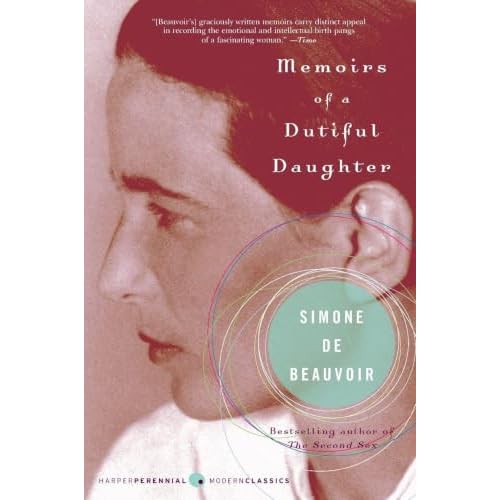
#6: Memoirs of a Dutiful Daughter — Best memoir
Simone de Beauvoir
The first autobiography: a bourgeois Catholic girlhood escaped through books, the friendship with Zaza that ended in tragedy, and the arrival at the Sorbonne — and at Sartre.
- The first and best volume of her autobiography — a mind assembling itself
- The portrait of Zaza is one of the great friendships in memoir
- Shows the lived roots of everything in The Second Sex
- Volume one of four — it ends just as the famous life begins
- Period detail of bourgeois Paris can run long
2 more titles round out our list, all shown in the quick picks above: The Woman Destroyed by Simone de Beauvoir (1967) — midlife, marriage, and self-deception in three novellas; The Coming of Age by Simone de Beauvoir (1970) — the taboo of old age given the Second Sex treatment.
How the top picks compare
Start here The Ethics of Ambiguity | The masterpiece The Second Sex | The fierce début She Came to Stay | The great novel The Mandarins | Best on death A Very Easy Death | |
|---|---|---|---|---|---|
|
|
|
|
|
| |
| Our rating | 9.0 /10 | 9.4 /10 | 8.7 /10 | 8.8 /10 | 8.9 /10 |
| Format | Philosophy | Philosophy / feminism | Novel | Novel | Memoir |
| First published | 1947 | 1949 | 1943 | 1954 | 1964 |
| Price | $9.98 | $11.07 | $18.95 | $17.72 | $9.27 |
| BUY NOW | BUY NOW | BUY NOW | BUY NOW | BUY NOW |
How to choose your Beauvoir
- Philosophy, fiction, or memoir
She mastered three forms; each carries the ideas differently.
Look forThe Ethics of Ambiguity for the ideas bare, The Mandarins for them lived, the memoirs for them remembered.AvoidDeciding after one form that she isn't for you — the novelist and the philosopher convert different readers. - Translation and edition
The Second Sex exists in two very different English versions.
Look forThe 2009 Borde and Malovany-Chevallier unabridged translation of The Second Sex.AvoidThe 1953 Parshley version — abridged by a zoologist who cut much of the philosophy. - Appetite for length
Her masterpieces are long; her doors are short.
Look forEthics of Ambiguity and A Very Easy Death as short entries; the monuments once she's earned your weeks.AvoidOpening with all 800 pages of The Second Sex and stalling in the biology chapters.
Which Simone de Beauvoir book should I read first?
The Ethics of Ambiguity — around 160 pages, and the clearest statement of existentialist ethics the movement produced. If you prefer fiction first, The Mandarins; if you want the famous argument, go straight to The Second Sex in the 2009 unabridged translation.
What is The Second Sex actually about?
How woman was constructed as the Other — defined against man rather than as a subject in her own right. Beauvoir works through biology, psychoanalysis, history, myth, and the stages of women’s lives to show that femininity is made, not born — ‘one is not born, but rather becomes, a woman.’
Was de Beauvoir just Sartre's follower?
No — the record increasingly shows influence running both ways. Her notion of ambiguity corrects his early dualism; The Ethics of Ambiguity built the ethics he promised and never delivered; and scholars have traced ideas in Being and Nothingness to her earlier diaries and to She Came to Stay.
Why should Yalom readers care about A Very Easy Death?
It’s one of the finest short accounts of a death ever written — a philosopher watching her mother die and refusing every consolation that doesn’t hold. It pairs naturally with The Death of Ivan Ilyich and Yalom’s Staring at the Sun as core reading on mortality faced without flinching.
Bottom line
The Ethics of Ambiguity for the ideas, The Second Sex for the monument, The Mandarins for the novel, A Very Easy Death for the deathbed truth. Buy the 2009 translation of The Second Sex, and stop calling her Sartre’s companion.