Thich Nhat Hanh’s Books: Where to Start and What to Read Next
Thich Nhat Hanh — Thay, to his students — carried Zen out of the monastery and into traffic jams, kitchens, and war zones, and became one of the two figures (with the Dalai Lama) who taught the West to breathe. The gentleness is the surface; underneath is a rigorous teacher exiled for peacemaking. Eight books, ordered for the reader.
Start Thich Nhat Hanh with The Miracle of Mindfulness — the wartime letters that turned breathing and dishwashing into practice — then Peace Is Every Step for mindfulness carried into daily mess. The Heart of the Buddha’s Teaching is the doctrinal map when you want the architecture behind the gentleness.
- Presence is the entire teaching Every book circles one move: return to the breath, arrive in the present, and discover the moment is livable. The simplicity is deceptive — it’s a lifetime’s practice disguised as a suggestion.
- The gentleness carries steel Thay coined ‘engaged Buddhism’ during the Vietnam War and was exiled nearly forty years for it — the calm prose was written by a man who buried students and negotiated with governments.
- Emotions are tended, not fought His signature move — embracing anger or fear ‘like a mother holding a crying baby’ — is emotion regulation the clinical literature caught up with decades later: recognition and care instead of suppression or venting.
This guide is part of our books on the meaning of life silo — Thay’s answer to the meaning question is the shortest on the shelf: the meaning is not elsewhere; wash the dishes to wash the dishes.
Who Thay was — and why the simplicity is deceptive
The biography explains the books. A Vietnamese Zen monk who watched his country burn, Nhat Hanh refused the choice between contemplation and action — founding relief corps, nominating no one less than himself for exile by calling for peace, spending four decades barred from home while building Plum Village into the West’s largest mindfulness community. Engaged Buddhism was his coinage: the cushion and the burning village are one practice. The famous gentleness is not naivety; it is what discipline looks like after it has survived a war.
The style is its own argument. Where Western philosophy builds systems, Thay repeats — breath, smile, tangerine, dishes — until the repetition becomes the practice it describes. Readers who arrive wanting complexity sometimes mistake this for thinness; the correction is The Heart of the Buddha’s Teaching, where the full doctrinal machinery (Four Noble Truths, interbeing, the twelve links) is laid out with quiet precision. The simple books are the advanced books, applied.
The reading path — where to start and where it deepens
Start with The Miracle of Mindfulness: letters written in 1974 to a colleague in the war-relief school, teaching attention through dishes and tangerines — still the purest dose of the voice. Then Peace Is Every Step, the most giftable book in the genre: tiny chapters carrying the practice into red lights, arguments, and dish soap. Those two are the core; many readers need nothing else.
Deepen along your need. The Heart of the Buddha’s Teaching for the doctrine; Anger for his most therapeutic single book — the crying-baby method applied to the hardest emotion; No Mud, No Lotus for suffering itself, and the line that summarizes his whole psychology. You Are Here preserves the live teaching voice, Being Peace is the engaged-Buddhism classic, and How to Love distills the relational teaching to pocket size. All of it is one book, really — the practice of arriving — refracted through different doors.
Independently researched and ranked by our editorial team. As an Amazon Associate, this site earns from qualifying purchases made through the links below.




#1: The Miracle of Mindfulness — Best starting point
Thich Nhat Hanh
Written from the middle of a war as instruction for exhausted relief workers: how to wash dishes to wash dishes. Fifty years on, still the purest introduction to mindfulness in print.
- Thich Nhat Hanh’s warm, concrete voice — washing dishes in order to wash dishes
- Brief, luminous, and endlessly re-readable
- Rooted in real practice, told through letters to a fellow worker in wartime
- The Buddhist framing may not suit strictly secular readers
- Contains no research talk at all, for those who need the evidence base
#2: Peace Is Every Step — Best for daily life
Thich Nhat Hanh
Tiny self-contained chapters — red lights as bells of mindfulness, anger as compost, walking as arrival — that make the whole day the practice ground. The most giftable book in the genre.
- Mindfulness carried into anger, relationships, traffic, and ordinary mess
- Tiny self-contained chapters — readable in any spare minute
- Perhaps the most giftable book in the genre
- Overlaps substantially with The Miracle of Mindfulness
- Aphoristic rather than systematic — no program to follow
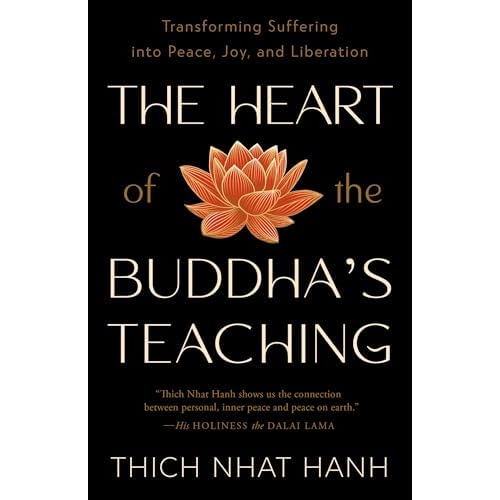
#3: The Heart of the Buddha's Teaching — Best doctrinal map
Thich Nhat Hanh
Four Noble Truths, Eightfold Path, interbeing — the complete Buddhist framework in Thay’s plain voice. The book that shows the simple teachings were the advanced ones all along.
- The complete doctrinal architecture — Four Noble Truths, Eightfold Path, interbeing — in plain voice
- Shows the rigorous system underneath the tangerine simplicity
- Interprets classic doctrine with his signature therapeutic warmth
- The reference the practice books quietly assume
- Denser and slower than everything else on his shelf
- Readers wanting only secular practice may not need the full machinery
#4: Anger: Wisdom for Cooling the Flames — Most therapeutic
Thich Nhat Hanh
Anger tended like a suffering child — recognized, embraced, looked into — rather than suppressed or vented. His single most clinically resonant book, decades ahead of the emotion-regulation literature.
- The crying-baby metaphor — tend your anger, don’t feed or fight it — reframes everything
- Mindful breathing and deep listening taught simply enough to use tonight
- Neither suppression nor venting — the third way the research also endorses
- Gentle without being soft on the damage anger does
- Anecdotal and devotional where the CBT shelf is systematic
- Readers in high-conflict situations may need more structure first
#5: No Mud, No Lotus — Best on suffering
Thich Nhat Hanh
The title is the thesis: no suffering, no awakening — the lotus grows from the mud, not from marble. His most direct treatment of pain, and the closest thing to his psychology in one short book.
- His most direct treatment of suffering — the thesis is the title and it holds
- The mindfulness-of-suffering practices are concrete and short
- The right book for pain that other books try to talk you out of
- Distills his whole psychology into one slim volume
- Repeats material from earlier books — the trade-off of the late distillations
- Brevity means depth-seekers will want Heart of the Buddha’s Teaching behind it
#6: You Are Here — Best live teaching
Thich Nhat Hanh
Adapted from retreat talks: the core practices taught in his speaking voice, looser and warmer than the composed books. For readers who want to sit in the hall rather than the library.
- The live retreat voice — looser, warmer, and more spontaneous than the composed books
- Core practices (breath, walking, embracing emotion) taught as spoken instruction
- The interbeing teaching lands especially clearly in talk form
- Short enough for one sitting, built for many
- Transcribed talks meander where the written books march
- Overlaps substantially with The Miracle of Mindfulness
2 more titles round out our list, all shown in the quick picks above: Being Peace by Thich Nhat Hanh (1987) — meditation and activism refusing to be separated; How to Love by Thich Nhat Hanh (2014) — the relational teaching distilled to aphorism.
How the top picks compare
Best starting point The Miracle of Mindfulness | Best for daily life Peace Is Every Step | Best doctrinal map The Heart of the Buddha's Teaching | Most therapeutic Anger: Wisdom for Cooling the Flames | Best on suffering No Mud, No Lotus | |
|---|---|---|---|---|---|
|
|
|
|
|
| |
| Our rating | 9.1 /10 | 8.7 /10 | 8.8 /10 | 8.6 /10 | 8.5 /10 |
| Format | Contemplative classic | Contemplative classic | Buddhist philosophy | Buddhist psychology | Buddhist psychology |
| First published | 1975 | 1991 | 1998 | 2001 | 2014 |
| Price | $9.40 | $10.45 | $9.99 | $8.47 | $11.62 |
| BUY NOW | BUY NOW | BUY NOW | BUY NOW | BUY NOW |
How to choose your Thich Nhat Hanh book
- Practice, doctrine, or medicine
The shelf divides into how-to-practice, what-Buddhism-says, and books aimed at a suffering.
Look forMiracle and Peace Is Every Step for practice; Heart of the Buddha's Teaching for doctrine; Anger or No Mud, No Lotus when something specific hurts.AvoidStarting with the doctrine book because it looks most substantial — with Thay, the practice books are the substance. - Tolerance for repetition
The repetition is pedagogical — the same bell struck from different angles.
Look forIf repetition soothes you, read widely; if it frustrates you, the core two plus Heart covers the essential range.AvoidJudging the project by one pocket book — the Essentials series is deliberately minimal, not the full teaching. - Where your skepticism lives
Different readers stumble on different thresholds — religion, simplicity, or politics.
Look forSecular and science-adjacent readers do fine with Miracle; the doctrine-shy can stay with practice books indefinitely; Being Peace answers the escapism charge.AvoidWaiting until you 'believe' something — the entire method is empirical: breathe, attend, and check the results yourself.
Which Thich Nhat Hanh book should I read first?
The Miracle of Mindfulness — it’s the origin document and still the purest dose of the teaching. If you want something even lighter to begin, Peace Is Every Step works as a first book and pairs with it naturally.
Was Thich Nhat Hanh religious, or is this secular mindfulness?
Both, deliberately. He was a Zen monk teaching from a full Buddhist framework, but he built the front door so anyone could enter: breath and attention require no beliefs. The doctrine is there in Heart of the Buddha’s Teaching when and if you want it.
What is 'interbeing'?
His signature concept: nothing exists independently — the paper contains the cloud, the logger, the sun. It’s the Buddhist teaching of dependent origination made tactile, and the root of both his ecology and his ethics: harming anything is harming the web you are.
How does Thay differ from other mindfulness teachers?
Lineage and stakes. Modern secular mindfulness (Kabat-Zinn onward) descends substantially from him, but the original carries what the derivatives often drop: ethics, community, and the engaged insistence that practice includes the burning world — he taught breathing in a war, not a wellness app.
Bottom line
Miracle of Mindfulness to start, Peace Is Every Step for daily life, Heart of the Buddha’s Teaching for the architecture, Anger when something specific burns. One teaching through every door: arrive, breathe — the moment is livable.