Osamu Dazai Books in Order: A Reading Path Through the Great Confessional Novelist
No writer has made self-destruction more companionable. Osamu Dazai — dissolute aristocrat, five-time suicide attempter, dead at 38 — wrote confession as fiction with such intimacy that generations of readers, especially young ones, feel personally addressed. His books are dark, short, and stranger and funnier than his legend admits. Here's the path through them.
Start Osamu Dazai with No Longer Human — the confessional masterpiece of a man performing humanity he cannot feel — then The Setting Sun for the postwar novel that named a declining class. Read Schoolgirl and the stories to see the lighter, funnier writer the two dark masterpieces overshadow.
- The clown is the confession Dazai’s central device — Yozo’s clowning in No Longer Human — is alienation’s survival strategy: perform the human so no one checks whether you are one. The comedy and the despair are the same gesture.
- Decline is his great subject A fallen aristocrat writing a falling class in a defeated country: The Setting Sun made his family’s decline Japan’s, and the word shayozoku — setting-sun people — entered the language.
- Read beyond the two dark masterpieces Schoolgirl’s voice, the retold fairy tales, the comic stories — Dazai was various, playful, and technically brilliant, and the shelf misreads him as one long suicide note only by skipping most of it.
This guide is part of our existentialism for readers silo — Dazai is the confessional wing of the tradition: what alienation feels like from inside a self that can perform belonging but not feel it.
The essential path — Human, Setting Sun, Schoolgirl
Begin with No Longer Human (1948), the book that is to Japanese literature roughly what The Stranger is to French: Yozo’s three notebooks, from the childhood discovery that he cannot feel what others feel — only mimic it — through the clowning, the women, the morphine, to the final line’s quiet annihilation. The Japanese title, Ningen Shikkaku, means disqualified as a human being, and the book’s eerie power is how gently it speaks: confession without self-pity, wit without warmth, a voice readers recognize with a shock. Weeks after finishing it, Dazai drowned himself; the proximity is unignorable and the novel survives it as art.
The Setting Sun (1947) is the other summit, and the better-made novel: Kazuko, an impoverished aristocrat’s daughter, watches her exquisite mother — the last lady in Japan — die with the old world, while her brother Naoji fails to survive the new one, and she chooses scandal, a child, and life. Written from a woman’s diary voice with complete conviction, it made Dazai the laureate of postwar collapse. Schoolgirl (1939), the novella that first made him famous, shows the register his legend hides: a Tokyo girl’s single day, narrated in a flickering interior voice — funny, petulant, suddenly desolate — decades ahead of its time.
The rest of the shelf — buffoonery, fairy tales, late stories
The Flowers of Buffoonery (1935) is the young Dazai’s dry run at his life’s material: Yozo again — the same name, years before No Longer Human — recovering in a sanatorium after a double suicide attempt he survived and she did not, while the author interrupts his own scenes to mock their sincerity. The metafictional clowning shows exactly what the clown was for. Early Light collects late work including the astonishing title story — Dazai’s house burning in the firebombing, told with his signature shrug — and One Hundred Views of Mount Fuji, the closest he came to serenity.
Crackling Mountain and Other Stories gathers his retold fairy tales and classical riffs — cruel, hilarious, technically dazzling — the clearest evidence that Dazai was a craftsman playing games, not a diarist bleeding on paper. Self Portraits collects the autobiographical stories straight: the Tsugaru childhood, the failed attempts, the literary feuds, told with the comic timing the novels weaponize. Read the stories after the novels and the legend rearranges: not a man who could only confess, but a virtuoso who chose confession as his instrument — and played it better than anyone.
Independently researched and ranked by our editorial team. As an Amazon Associate, this site earns from qualifying purchases made through the links below.




#1: No Longer Human — Start here
Osamu Dazai (tr. Donald Keene)
Yozo’s three notebooks: unable to feel what humans feel, he performs humanity as clowning until the performance fails. Japan’s perennial bestseller of despair, and one of the great first-person voices anywhere.
- One of the great first-person voices anywhere — confession without self-pity
- The clowning-as-survival mechanism is rendered with terrible precision
- Short, structurally perfect: three notebooks and a frame that lands the final blow
- Keene’s translation is itself a classic of the craft
- Genuinely dark, and intimate about suicide — timing and state matter for this one
- The women exist as instruments of Yozo’s fate — the book knows it, but it wears
#2: The Setting Sun — The other summit
Osamu Dazai (tr. Donald Keene)
Kazuko’s diary of a falling house: the last aristocratic mother dying beautifully, the brother failing to live, and her own scandalous choice of life. The novel that named an era — and Dazai’s best-constructed book.
- Dazai’s best-constructed novel — the diary voice of Kazuko is complete conviction
- The mother’s death scene is among postwar literature’s finest
- Named an era: aristocratic decline as Japan’s own, without allegory’s stiffness
- Ends in chosen life, not annihilation — the counterweight to No Longer Human
- Naoji’s notebooks tilt melodramatic against the book’s restraint
- Some period context (the Chekhov echoes, the class politics) rewards footnotes readers won’t have
#3: Schoolgirl — The early voice
Osamu Dazai (tr. Allison Markin Powell)
The novella that made him famous: a Tokyo schoolgirl’s interior monologue from waking to sleep — petulant, funny, abruptly profound. The lighter Dazai his legend hides, in a superb modern translation.
- A teenage girl’s interior voice, done in 1939, decades ahead of its technique
- Funny and desolate in the same sentence — the full Dazai register in miniature
- Powell’s translation catches the flicker perfectly
- An afternoon’s read that reframes the whole dark legend
- Plotless by design — readers wanting story will find a single ordinary day
- So slim that the price-per-page stings
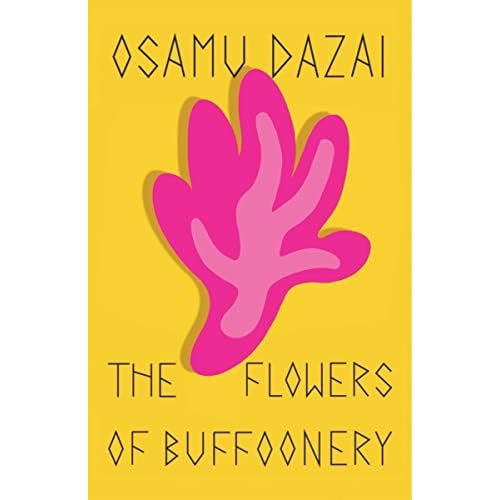
#4: The Flowers of Buffoonery — The dry run
Osamu Dazai (tr. Sam Bett)
A sanatorium after a survived double suicide: the young Dazai narrating his own material while heckling his narration. Metafictional, painful, and the skeleton key to No Longer Human.
- The skeleton key to No Longer Human — Yozo, younger, the clown mechanism exposed
- The self-interrupting narrator is startlingly modern metafiction
- Bett’s translation keeps the comedy sharp against the grief
- Short enough to read as the masterpiece’s afterword — and it should be
- The metafictional heckling divides readers — some hear evasion, not honesty
- Assumes the biographical context; standalone readers miss half the charge
#5: Early Light — The late stories
Osamu Dazai (tr. Ralph McCarthy & Donald Keene)
Three late pieces including the title story’s firebombed Tokyo and the famous Fuji sketches — Dazai’s comedy of disaster at full maturity. A slim, perfect introduction to the story writer.
- The title story’s firebombed Tokyo is Dazai’s deadpan at full power
- One Hundred Views of Mount Fuji is his closest pass at peace — essential
- Three pieces, perfectly chosen — the ideal story-writer introduction
- New Directions’ slim format suits his velocity
- Forty-odd pages — an appetizer, priced as one
- The translations span two hands; the register shifts slightly between stories
#6: Crackling Mountain and Other Stories — The craftsman's case
Osamu Dazai (tr. James O’Brien)
Dazai the virtuoso: classical tales and folk stories rewritten with wicked timing and modern despair. The clearest proof that the confessional voice was an instrument, not an accident.
- The retold fairy tales are cruel, hilarious, and technically dazzling
- The clearest evidence Dazai was a craftsman choosing effects, not a bleeding diarist
- O’Brien’s selection spans the career, showing the range
- The classical riffs read fresh with zero knowledge of the originals
- Older translation with occasional stiffness the new wave has spoiled us against
- Tonal whiplash between comic and desolate pieces — by design, but real
2 more titles round out our list, all shown in the quick picks above: Self Portraits by Osamu Dazai (tr. Ralph McCarthy) (1991) — the autobiographical stories behind the novels; A Shameful Life by Osamu Dazai (tr. Mark Gibeau) (2018) — No Longer Human, retranslated closer to the bone.
How the top picks compare
Start here No Longer Human | The other summit The Setting Sun | The early voice Schoolgirl | The dry run The Flowers of Buffoonery | The late stories Early Light | |
|---|---|---|---|---|---|
|
|
|
|
|
| |
| Our rating | 9.4 /10 | 9.1 /10 | 8.5 /10 | 8.3 /10 | 8.2 /10 |
| Format | Novel / classic | Novel / classic | Novella | Novella | Stories |
| First published | 1948 | 1947 | 1939 | 1935 | 1946 |
| Price | $10.90 | $10.54 | – | $9.10 | $6.20 |
| BUY NOW | BUY NOW | BUY NOW | BUY NOW | BUY NOW |
How to read Dazai (and in what order)
- Publication order versus impact order
Chronology starts light; the canon starts dark.
Look forImpact order for most readers — No Longer Human, then The Setting Sun, then backward into the lighter work as relief and revelation.AvoidReading only the two dark masterpieces — the stories and Schoolgirl are the corrective to the one-note legend. - Translation matters
Keene’s classic versions and the new wave read differently.
Look forKeene for the canonical music; Bett, Powell, and Gibeau for a rawer, more contemporary Dazai — both are faithful to something real.AvoidJudging the prose from one translation alone if a passage feels stiff — the other camp probably rendered it alive. - Your state while reading
Dazai addresses despair intimately, which is his gift and his risk.
Look forThe strange comfort many readers report — being understood in the dark is company, and Dazai is superb company.AvoidBinging the darkest work in a low season without counterweight — space it with the comic stories, or with daylight.
What order should I read Osamu Dazai's books?
No Longer Human first — it’s the essential Dazai and the reason to care. Then The Setting Sun, then Schoolgirl and The Flowers of Buffoonery, then the story collections. Strict chronology works only if you already know you love him.
Is No Longer Human autobiographical?
Substantially — Yozo’s clowning, the art school, the double suicide attempt survived, the morphine, all track Dazai’s life, and he died weeks after finishing it. But it’s shaped, voiced, and controlled as only deliberate fiction is; the honest answer is autofiction before the word existed.
Why is Dazai so popular with young readers now?
Because performing a self you don’t feel is the modern condition, and Yozo describes it without flinching or preaching. Add the manga and anime adaptations (and Bungo Stray Dogs’ Dazai character) that funnel new readers to the novels, and a 1948 confession keeps outselling most contemporary fiction.
Is Dazai's work too dark to enjoy?
Dark, yes; joyless, no — the books are funny, sentence by sentence, in a deadpan way the summaries miss, and readers overwhelmingly report the darkness as companionable rather than crushing. That said, No Longer Human sits close to suicide; if that topic is personally live for you, this is a sensitive shelf, and support is worth having alongside — we’re happy to point toward resources if useful.
Bottom line
No Longer Human for the masterpiece, The Setting Sun for the fall of a world, Schoolgirl and the stories for the writer the legend hides. Confession as craft, despair as company — nobody has done either better.