Simone Weil Books: Where to Start With the Philosopher of Attention
Camus called her the only great spirit of our time. A philosopher who left teaching for factory lines, a mystic who refused baptism, dead at 34 after refusing to eat more than occupied France's rations — Simone Weil is the twentieth century's most demanding thinker, and her subject was attention: the rarest and purest form of generosity. Eight books, ranked.
The best place to start with Simone Weil is Gravity and Grace — the aphoristic notebook selections that carry her core ideas in fragments of terrible clarity. Add Waiting for God for the spiritual autobiography and the essay on attention, and Zaretsky’s The Subversive Simone Weil for the best modern guide to her life and thought.
- Attention is the whole ethics Weil’s central claim — attention, taken to its highest degree, is the same thing as prayer, and the same thing as justice. Her essays derive an entire moral philosophy from the act of truly looking at another person.
- Affliction is her distinct subject Malheur — affliction that crushes the soul, not mere suffering — is Weil’s territory. No philosopher has written more precisely about extremity, because few lived so deliberately close to it.
- Read her in fragments first Weil finished almost nothing; her power lives in notebook fragments and essays. Gravity and Grace’s aphorisms are the honest introduction — the systematic books came later, assembled by others.
This guide is part of our existentialism for readers silo — Weil stands at its mystic edge: where Sartre found absurdity and freedom, she found gravity, grace, and the discipline of waiting.
The essential Weil — notebooks and testimony
Gravity and Grace is the entry point by consensus: Gustave Thibon’s selection from the notebooks Weil left him, arranged by theme — gravity (the soul’s downward mechanics), grace (the interruption), attention, affliction, decreation. The fragments read like physics for the inner life, one sentence sometimes carrying a book’s weight. Waiting for God pairs the spiritual autobiography — her letters to Father Perrin explaining why she stayed outside the Church she loved — with the essays, including “Reflections on the Right Use of School Studies,” which contains her whole philosophy of attention in twenty pages: study as training for prayer, prayer as attention absolute.
The Need for Roots is the late masterwork — commissioned by the Free French to diagnose what uprooted Europe, delivered instead as a theory of what human beings require: order, liberty, obedience, honor, truth. De Gaulle reportedly called her mad; the book has outlasted the judgment.
The wider shelf — essays, force, and the guides
“The Iliad, or the Poem of Force” is Weil’s most famous single essay — Homer read as the epic of force turning persons into things, written as France fell, and still the deepest short thing written about violence. It anchors the Penguin Anthology, the best single-volume tour of the essays. The First and Last Notebooks serve readers who want the workshop unedited — the raw sequence Thibon’s selection tidied.
For guides: Zaretsky’s The Subversive Simone Weil is the modern standard — five ideas (affliction, attention, resistance, roots, the good) traced through the impossible life, sympathetic without hagiography. Coles’s Simone Weil: A Modern Pilgrimage reads her through a psychiatrist’s eyes — the anorexia question, the self-erasure — honest about the pathology readings while defending what exceeds them. Start with Zaretsky if you want one companion; the life illuminates the work and unsettles it in equal measure.
Independently researched and ranked by our editorial team. As an Amazon Associate, this site earns from qualifying purchases made through the links below.



#1: Gravity and Grace — Best overall
Simone Weil
Thibon’s arrangement of the notebooks: gravity, grace, attention, affliction, decreation. The sentences read like physics for the soul — the consensus door into Weil’s thought.
- The consensus entry point — Weil’s core in fragments of terrible clarity
- Thibon’s thematic arrangement gives the notebooks usable shape
- Single sentences carry book-weight — the highest density on the shelf
- The vocabulary (gravity, grace, decreation, attention) unlocked for everything else
- Thibon’s selection and ordering are interventions — this is curated Weil
- Fragments frustrate readers wanting sustained argument
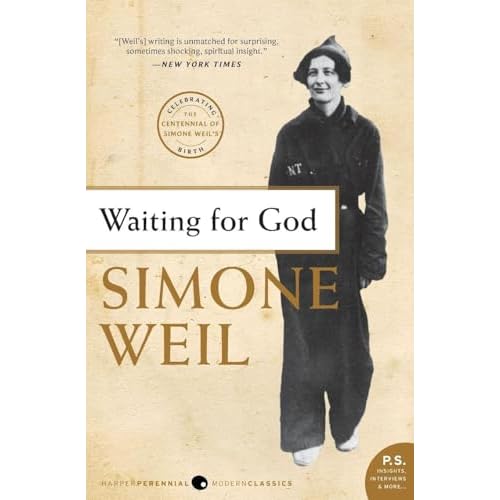
#2: Waiting for God — The testimony
Simone Weil
Letters to Father Perrin on staying outside the Church, plus the essays — including the school-studies piece that derives prayer, ethics and education from attention alone.
- The spiritual autobiography: the Perrin letters explain the threshold position in her own voice
- Contains the school-studies essay — her whole philosophy of attention in twenty pages
- The refusal of baptism argued as solidarity — the most modern religious stance on record
- Essays and letters balance the notebooks’ compression
- The explicitly theological register tests secular patience in places
- Requires tolerance for a mind that refuses every available category
#3: The Need for Roots — The late masterwork
Simone Weil
Commissioned as a report for the Free French, delivered as a theory of rootedness: the soul’s needs enumerated like nutrients. Political philosophy with no living rival for seriousness.
- The needs of the soul enumerated like nutrients — political philosophy at maximum seriousness
- Uprootedness diagnosis reads truer each decade — the modern condition named in 1943
- The obligations-before-rights argument remains genuinely radical
- Her most sustained, systematic writing — the counterweight to the fragments
- Written as a wartime report — the France-specific program sections date
- The most demanding entry point; readers should arrive via the notebooks
#4: The Subversive Simone Weil — Best guide
Robert Zaretsky
Zaretsky traces affliction, attention, resistance, roots and the good through the impossible biography — sympathetic, clear-eyed, and the best single book to read beside her.
- The best modern companion — five ideas traced through the impossible life
- Zaretsky is sympathetic without hagiography — the flaws and extremities stay visible
- Short, clear, and structured for readers meeting Weil for the first time
- The ‘life as argument’ framing solves the biography-or-philosophy problem
- A guide, not a substitute — readers sometimes stop here and shouldn’t
- Five-idea structure necessarily leaves territory unmapped
#5: Simone Weil: An Anthology — The essay tour
Simone Weil, ed. Siân Miles
Miles’s Penguin selection spans the factory journals, the political essays and the Poem of Force — the widest one-volume view of what Weil’s attention could do when aimed.
- The widest single-volume tour — factory journals, political essays, the Iliad essay complete
- Miles’s introduction is a superb compact orientation
- Shows the range the notebooks hide: reporter, activist, critic, mystic
- Penguin Modern Classics pricing for the essential essays
- Anthology trade-off: breadth over the notebooks’ cumulative intensity
- Selection ends where late theology deepens — pair with Waiting for God
#6: Simone Weil: A Modern Pilgrimage — The psychiatrist's reading
Robert Coles
Coles — child psychiatrist and moral writer — on Weil’s hunger, self-erasure and moral loneliness: honest about the pathology question, insistent on what it cannot explain.
- A psychiatrist’s reading that honors what pathology can’t explain
- Handles the anorexia and self-erasure questions with clinical care and moral respect
- Coles’s interviews and Harvard teaching give the portrait unusual texture
- Short — a weekend companion to the primary texts
- More meditation than biography — readers wanting full life detail need Pétrement
- Coles’s own religious investments color the reading, visibly
2 more titles round out our list, all shown in the quick picks above: The Iliad, or the Poem of Force by Simone Weil (1940) — the deepest short thing written on violence; First and Last Notebooks by Simone Weil (1970) — the notebooks raw, before selection.
How the top picks compare
Best overall Gravity and Grace | The testimony Waiting for God | The late masterwork The Need for Roots | Best guide The Subversive Simone Weil | The essay tour Simone Weil: An Anthology | |
|---|---|---|---|---|---|
|
|
|
|
|
| |
| Our rating | 9.2 /10 | 9.0 /10 | 8.8 /10 | 8.7 /10 | 8.6 /10 |
| Format | Philosophy / notebooks | Philosophy / letters | Philosophy | Biography / philosophy | Philosophy / anthology |
| First published | 1947 | 1950 | 1949 | 2021 | 1986 |
| Price | $15.19 | $11.30 | $27.63 | $13.98 | $18.76 |
| BUY NOW | BUY NOW | BUY NOW | BUY NOW | BUY NOW |
How to choose your Simone Weil
- Fragments or arguments
Weil’s thought survives in two forms — aphorism and essay.
Look forGravity and Grace if compressed intensity suits you; the Anthology or Waiting for God if you want reasoning at essay length.AvoidStarting with The Need for Roots — the late systematic work rewards readers who already know the notebooks' vocabulary. - With or without the life
The biography illuminates and unsettles the work.
Look forZaretsky as companion from the start — Weil's ideas were lived before written, and the life is half the argument.AvoidReducing the thought to the pathology — Coles models how to hold the anorexia question without letting it swallow the philosophy. - The religious question
Weil is a mystic who refused the Church — readers differ on the God parts.
Look forThe attention and affliction material first if you're secular — it stands without theology, as the cognitive scientists citing her confirm.AvoidSkipping Waiting for God on principle — the Perrin letters are precisely about refusing belonging, the most modern thing she wrote.
Where should I start with Simone Weil?
Gravity and Grace for the fragments, with Zaretsky’s The Subversive Simone Weil alongside as guide. If you prefer essays to aphorisms, Waiting for God — the school-studies essay on attention is the single best twenty pages to test whether Weil is your writer.
What does Weil mean by attention?
Not concentration — waiting. Attention for Weil is suspending the self and its readymade answers until the object, problem or person can actually be received. She calls it the rarest form of generosity, the substance of prayer, and the whole of ethics: to truly see an afflicted person is already justice.
Was Simone Weil a Christian?
A mystic on the threshold, deliberately. She had documented mystical experiences and loved the sacraments, yet refused baptism — solidarity with everything outside the Church, she said. The Perrin letters in Waiting for God make the refusal itself a spiritual position, and the most argued-over part of her legacy.
Why did Simone Weil die so young?
Tuberculosis, aggravated by her refusal to eat more than the rations of occupied France, in an English sanatorium in 1943, aged 34. The coroner wrote suicide; biographers dispute it — the self-limitation was consistent with her lifelong practice of sharing affliction. Coles handles the medical and moral questions most carefully.
Bottom line
Gravity and Grace for the fragments, Waiting for God for the testimony, Zaretsky for the guide, the Iliad essay for what her attention could do. Weil is not comfortable reading — she is corrective reading, and twenty minutes of her recalibrates what seriousness means.