Irvin Yalom’s Group Therapy Books: What to Read and When
Yalom didn't just write about group therapy — his textbook defined the field's shared vocabulary. But the textbook isn't the right entry for everyone. Here is the full shelf, ranked by who should read what.
Irvin Yalom’s The Theory and Practice of Group Psychotherapy (6th edition, with Molyn Leszcz) is the standard group therapy text worldwide. Clinicians in acute settings should add Inpatient Group Psychotherapy; general readers get the same ideas through his novel The Schopenhauer Cure or Christie Tate’s memoir Group.
- One textbook rules The Theory and Practice of Group Psychotherapy has been the standard text for fifty years; the 11 therapeutic factors are its core.
- Three ways in Textbook for clinicians, novel for general readers, memoir for the patient’s-eye view — pick your lane.
- The 6th edition matters Get the current Leszcz co-authored edition — it updates evidence and online groups.
For his complete bibliography beyond group work, see our Irvin Yalom books in order guide.
Why Yalom owns this field
Yalom’s central move was empirical: instead of theorizing about why groups heal, he asked patients. The result — the eleven therapeutic factors, from universality (“I’m not the only one”) to interpersonal learning — became the field’s shared vocabulary. Nearly every group-therapy training program on earth assigns his text.
His second move was the here-and-now: the group works best when it talks about what is happening inside the room, not just members’ outside lives. That single principle is why a Yalom-style group feels so different from a support circle.
Textbook, novel, or memoir — which entry point?
If you run groups or are training to, the textbook is non-negotiable and everything else is a supplement. If you are a general reader, do not start with a 700-page text: The Schopenhauer Cure teaches the same process through a story, and Yalom has said he wrote it partly as a teaching companion.
If you are considering joining a group yourself, Christie Tate’s Group shows the patient’s side — with the caveat that her therapist’s methods are far from standard practice.
Independently researched and ranked by our editorial team. As an Amazon Associate, this site earns from qualifying purchases made through the links below.




#1: The Theory and Practice of Group Psychotherapy — The standard text
Irvin D. Yalom & Molyn Leszcz
The definitive group therapy textbook for five decades, built on the eleven therapeutic factors. The 6th edition adds current evidence and online-group practice.
- The standard group text for fifty years; the eleven therapeutic factors remain the field’s shared vocabulary
- Dense with verbatim case vignettes that keep 700 pages readable
- The 6th edition (with Molyn Leszcz) updates online groups and current evidence
- It is a textbook, priced and sized like one — this is a study commitment, not a weekend read
- Beginners can drown in it; it works best read alongside actual group experience or supervision
#2: The Schopenhauer Cure — Best for general readers
Irvin D. Yalom
A full year of group therapy dramatized session by session — Yalom’s own teaching novel, and the painless way into his group-therapy thinking.
- The group-therapy sessions are the most realistic in fiction — Yalom uses them to teach actual group process, factor by factor
- Julius, the dying therapist, is Yalom’s most personal creation; his handling of his own prognosis models what the existential approach looks like from inside
- The alternating Schopenhauer biography chapters double as a compact, accurate introduction to the philosopher
- Many readers skim the biography chapters — they interrupt the group narrative at every cliffhanger
- Philip is written to be insufferable, and for some readers he succeeds too well to stay engaging
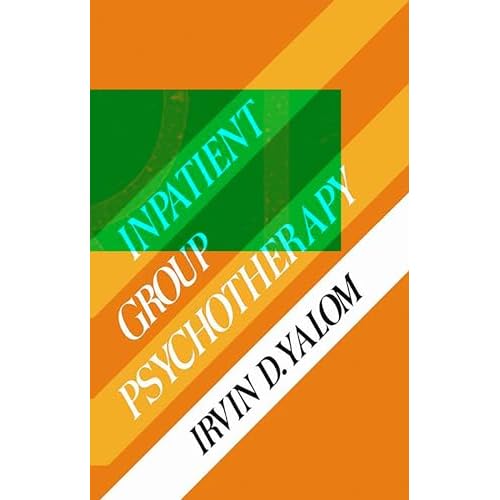
#3: Inpatient Group Psychotherapy — Best for acute settings
Irvin D. Yalom
The working manual for running groups on psychiatric wards, built around single-session agenda go-rounds. Written in 1983 but still the reference for acute work.
- The practical model — agenda go-rounds, single-session focus — still shapes acute inpatient groups
- Short and usable in a way the big textbook is not
- Honest about what group therapy can and cannot do in a hospital setting
- Published in 1983, when inpatient stays lasted weeks; today’s 3–5 day admissions need heavy adaptation
- Print availability is spotty and used-copy quality varies
#4: Every Day Gets a Little Closer — Most unusual
Irvin D. Yalom & Ginny Elkin
Therapist and patient wrote parallel journals of the same treatment, published side by side. A one-of-a-kind document of how differently the same hour lands.
- A one-of-a-kind format: therapist and patient wrote parallel journals of the same sessions, published side by side
- Shows, sometimes brutally, how differently the same hour lands on each side of the room
- Yalom is candid about his own vanity and blind spots decades before therapist self-disclosure was fashionable
- It is very 1974 — some interventions and attitudes read as dated
- Ginny’s impressionistic prose is polarizing; some readers skim her half
#5: Group — The patient's view
Christie Tate
A Reese’s Book Club memoir of one woman’s years in an unorthodox therapy group — raw, funny, and the best account of the patient’s side in print.
- Group therapy from the patient’s chair — raw, fast, and often very funny
- Shows the ‘no secrets’ group norm and interdependence in action better than any clinical description
- Tate’s honesty about her own behavior in group is the book’s engine
- Dr. Rosen’s methods are unorthodox to the point that clinicians warn against reading this as typical group therapy
- Explicit content and the narrator’s self-absorption wear on some readers
How to choose a group therapy book
- Your role
Clinician, trainee, or curious reader — the right book differs completely.
Look forTextbook for practice; novel or memoir for understanding.AvoidBuying the 700-page text to satisfy general curiosity. - Edition currency
Group therapy evidence and formats (especially online) have moved fast.
Look forThe 6th edition (2020) of the main text, co-authored with Molyn Leszcz.AvoidCheap used copies of the 4th/5th edition unless price is everything. - Setting match
Outpatient long-term groups and acute inpatient wards need different methods.
Look forInpatient Group Psychotherapy specifically for short-stay hospital work.AvoidApplying the inpatient agenda model unchanged to long-term outpatient groups.
What are Yalom's 11 therapeutic factors?
They are the mechanisms through which group therapy heals: instillation of hope, universality, imparting information, altruism, corrective family recapitulation, socializing techniques, imitative behavior, interpersonal learning, cohesiveness, catharsis, and existential factors. Yalom derived them by asking patients what helped.
Which edition of The Theory and Practice of Group Psychotherapy should I buy?
The 6th edition (2020), co-authored with Molyn Leszcz. It updates the research base and adds online-group practice, and it is the edition current training programs assign.
Can I learn group therapy from The Schopenhauer Cure?
You can learn what group process feels like — cohesion, feedback, the here-and-now — because Yalom wrote it partly as a teaching novel. Actual technique still requires the textbook and supervised experience.
Bottom line
Clinicians: the 6th-edition textbook, then the inpatient manual if you work acute. Everyone else: The Schopenhauer Cure for the process, Group for the patient’s chair. All roads lead back to the eleven therapeutic factors.