Marcus Aurelius’ Meditations: a summary of the emperor’s private notebook and its key ideas
The Meditations is a notebook a Roman emperor kept for himself, and it was never meant to be read by anyone else.
That single fact explains most of what puzzles new readers: the repetition, the lack of argument, the sudden shifts from a list of teachers to a reflection on rotting fruit or the death of Alexander the Great. This guide explains what the book is, how its twelve books are arranged, the five ideas that keep coming back, what scholars still argue about, and which translation to pick up, since with this book the translator changes almost everything.
The Meditations are private notes in Greek by Marcus Aurelius, Roman emperor from 161 to 180 CE, written in the last decade or so of his life, partly on military campaign. Book 1 lists what he owed to family and teachers; Books 2 to 12 are loosely ordered reflections on what lies in our control, the view from above, impermanence and death, the common good and the present moment.
- A notebook, not a treatise Marcus wrote for himself. The title was added later, and the order of entries is loose after Book 1.
- Five ideas carry the book Control, the view from above, impermanence and death, the common good, and the present moment.
- Mostly Stoic, not only Stoic Epictetus is the main source, but Heraclitus and even Epicurus appear, and how systematic the book is remains debated.
- The translation matters Versions differ widely in tone; Gregory Hays’s Modern Library translation is the plainest modern start.
What Marcus Aurelius' Meditations is, and why it was never meant for us
Marcus Aurelius was born in 121 CE, adopted into the imperial family under Hadrian, and ruled from 161 until his death in 180, for several years alongside his adoptive brother Lucius Verus. Much of his later reign was spent on the Danube frontier fighting the wars against the Marcomanni and other peoples, while a plague moved through the empire. The notes we call the Meditations belong to this period: written in Greek, the language of philosophy for an educated Roman, in the last decade or so of his life and partly on campaign. Two of the books carry short place notes in the manuscripts, one among the Quadi and one at Carnuntum, a legionary base on the Danube.
The name is not his. The manuscripts carry a Greek heading usually rendered as “to himself”, and later editors and translators gave the book the titles it now has. Marcus addresses himself in the second person throughout, reminding, scolding and steadying. Nothing suggests he expected strangers to read it, which is why it has no introduction, no definitions and no attempt to persuade anyone. If you want the broader case for what a summary like this one can and cannot give you, our guide to book summaries and study guides sets out the limits we work to.
People still read it for that reason. It is rare to hear a man with nearly unlimited power talking himself out of anger, vanity and fear of death, and repeating the same reminders because they did not stick the first time. The repetition is the point: these are notes for rereading, not chapters for a public.
How the twelve books of the Meditations are put together
Book 1 stands apart. It is a list of debts: what Marcus learned from his grandfather, his mother, his tutors and his adoptive father Antoninus Pius, ending with thanks to the gods. Each entry names a quality rather than a doctrine, such as plain living, patience with fools, or the habit of hearing an argument out. It reads like a portrait gallery of the people who made him.
Books 2 to 12 are different. They are made of numbered entries, some a single line, some a page long, on recurring themes with no plan anyone has fully agreed on. Book 2 opens with a reminder, written as if for the start of a day, that he will meet meddling, ungrateful and arrogant people and that they act from ignorance of what is good. Book 4 and Book 6 return again and again to change and death. Book 11 gathers more quotations from earlier writers, and Book 12 ends with the image of an actor dismissed from the stage before the play he expected is finished.
| Part | What you find there |
|---|---|
| Book 1 | Debts of character to family, teachers, Antoninus Pius and the gods |
| Books 2 and 3 | Short notes with place headings in the manuscripts; time running out, the ruling mind |
| Books 4 to 6 | Change, death, the vastness of time, the hive and the bee, providence or atoms |
| Books 7 to 10 | Longer entries, quotations, how to treat people who do wrong, the duty of the day |
| Books 11 and 12 | More borrowed lines, the soul as a sphere, the actor leaving the stage |
Five ideas Marcus returns to again and again
What is and is not in our control. Marcus took this from Epictetus, the former slave turned Stoic teacher whom he never met but read closely. Our judgements, intentions and actions belong to us; our body, reputation, property and other people’s choices do not. Marcus calls the thinking part of us the ruling centre, and much of the book is him reminding himself that harm only becomes harm through the opinion he forms about it. Our guide to Epictetus’s books covers where this idea is set out most clearly.
The view from above. Several entries ask the reader, meaning Marcus himself, to picture human life from a great height: armies, weddings, markets, lawsuits, all small and passing. The effect is not contempt for people but a change of scale. An emperor’s quarrels shrink to the size of an ant hill, and so does his fame.
Impermanence and death. No theme is more frequent. Marcus lists the dead: philosophers, doctors, generals, whole courts of earlier emperors, all gone. He notes that Alexander the Great and his mule driver ended in the same state. Death is presented as a natural change, like the ripening and falling of fruit, and the fear of it as a mistaken judgement.
Acting for the common good. Marcus sees every person as part of one rational community, and human beings as made for working together, like the parts of a body. One entry in Book 6 puts it in a farmyard image: what is not good for the hive is not good for the bee. The wrongdoer is a fellow member who has made a mistake, which is why so many entries deal with irritation at other people.
The present moment. Since past and future are not ours, Marcus writes, the only life anyone can lose is the one being lived now, and a long life and a short one lose the same thing. The idea links back to death: if all we ever have is this moment, the length of a life matters less than what is done with it.
The Meditations on death, read beside existential psychology
Irvin Yalom’s Existential Psychotherapy (1980) names death as one of four givens of human existence, with freedom, isolation and meaninglessness, and his later book Staring at the Sun (2008) is about the fear of death and how facing it can change a life. In that book Yalom leans on Epicurus more than on the Stoics. Still, the overlap with Marcus is easy to see: both treat death not as a morbid topic but as the background that gives the present its weight.
The difference is just as instructive. Marcus answers death with a cosmology: the universe is ordered, change is its nature, and a rational being should accept its part. Existential psychology starts from the opposite assumption, that no such order guarantees meaning and that we have to make it. Viktor Frankl, whose Man’s Search for Meaning is often shelved next to Marcus, sits somewhere between: freedom of attitude is Stoic in spirit, but the search for meaning is his own. Dostoevsky, who once faced a firing squad and was reprieved, gave a version of that experience to Prince Myshkin in The Idiot, where the present moment becomes unbearably precious.
The Meditations describe ideas about mortality; they are not a substitute for help. If thoughts about death or loss are weighing on you, a book sits alongside professional support, never in place of it. In the US you can call or text 988.
People and terms in Marcus Aurelius' notebook
| Name or term | Who or what | Why it matters |
|---|---|---|
| Antoninus Pius | Marcus’s adoptive father and predecessor as emperor | The longest portrait in Book 1, a model of a ruler |
| Junius Rusticus | Stoic teacher and statesman | Thanked for lending Marcus his copy of Epictetus |
| Epictetus | Stoic teacher, a former slave | Main source for the line between what is and is not ours |
| Fronto | Marcus’s teacher of rhetoric | Thanked for showing him the falseness of court life |
| Ruling centre | The reasoning part of the self | Where judgement happens and where freedom lies |
| Providence or atoms | A recurring either-or | Marcus asks how to live whether the world is ordered or random |
Book 1 is worth reading slowly for the people in it. Marcus does not thank Rusticus for a doctrine but for practical things: learning to write plain letters, to be easily reconciled with people who had offended him, and for the loan of Epictetus. The portrait of Antoninus Pius, patient, careful with public money and uninterested in flattery, is the closest the book comes to a picture of the ruler Marcus wanted to be.
How Stoic, and how systematic, is the Meditations?
Popular books call Marcus the model Stoic, and the label is fair as far as it goes: the vocabulary, the cosmology and the debt to Epictetus are Stoic. But he also quotes Heraclitus often, borrows from Plato, and keeps asking whether the world might be atoms in random motion, the Epicurean view, without settling the question. Some readers see a loyal Stoic; others see a man who used whatever helped and held the system more loosely than the school did.
The larger debate is about form. The French historian Pierre Hadot, in The Inner Citadel, read the notes as spiritual exercises: a practice of rewriting the doctrines of Epictetus, built around three disciplines of judgement, desire and action, rather than a diary of private moods. That reading was partly aimed at an older view of Marcus as a tired, gloomy man pouring out his feelings. Other scholars accept that the book is a practice but doubt that it follows any plan so closely, and stress its literary craft. These are scholarly positions, not settled facts, and a first reading does not need to choose between them.
How the Meditations ends, and what the last image means
A notebook has no plot to spoil, but the final entry of Book 12 is famous enough to mention. Marcus imagines a man complaining that he has played only three acts of the five he expected. The answer is that the one who brought him on stage decides when the play is complete, and that the actor can leave without resentment, since the one who dismisses him does so without ill will. It gathers the book’s main threads, death, acceptance and the whole that each life serves, into one scene.
Whether that close was placed there by Marcus or reflects how the manuscripts came down to us is hard to know, and readers should not make too much of the order. The image works because it repeats, in its last form, a reminder Marcus had been giving himself for twelve books.
Which translation of the Meditations to read first
Translations of the Meditations differ a great deal, so the translator’s name matters more than the cover. Victorian versions such as George Long’s are formal and full of thee and thou. Martin Hammond’s Penguin Classics translation is close to the Greek with good notes. Gregory Hays’s translation for the Modern Library is the plainest and most readable modern English, with a clear introduction on Marcus’s life and Stoicism, and it is the one we suggest for a first reading. It is also the source of a popular phrase from Book 5, “what stands in the way becomes the way”, which many people meet before they meet the book. Be wary of lines labelled as Marcus Aurelius quotes online: many are loose paraphrases, and some are not in the text at all.

Marcus Aurelius, translated by Gregory Hays
All twelve books in Gregory Hays’s plain modern translation, with an introduction on Marcus’s life, his reign and the Stoic background. About 272 pages in this Modern Library paperback. Check the translator’s name before you buy, since translations of the Meditations differ widely in tone.
Who may not get on with Marcus Aurelius
Readers who want an argument built step by step will find the book frustrating: it states, repeats and moves on. Anyone hoping for a manual will find no programme, only a man’s reminders to himself. The cosmology, an ordered universe guided by reason, does not suit every modern reader, and some find the calm about death and other people’s wrongdoing cold. And because the notes were private, the book says almost nothing about the wars, the court or the empire Marcus actually ran; readers looking for history will need a biography.
What to read after the Meditations: Epictetus, Seneca and two guides
Start with Epictetus, Marcus’s main Stoic source. His sayings were written down by his pupil Arrian as the Discourses and the short Handbook, and reading them shows where many of Marcus’s reminders come from, often in sharper form. Marcus himself thanks Rusticus in Book 1 for putting Epictetus in his hands.

Epictetus, translated by Robert Dobbin
A selection of the Discourses with the Handbook, recorded by Arrian. About 304 pages in this Penguin Classics edition. The best next book for seeing where Marcus’s line between what is and is not ours comes from.
Seneca is the other great Roman Stoic, a century before Marcus and very different in voice: a senator and adviser to Nero writing polished letters to a friend. His letters cover many of the same themes, including time, death and friendship, but argue them out at length and with more literary wit.

Seneca
A Penguin selection of Seneca’s letters on time, death and friendship. About 254 pages in this edition. Fuller and more argued than Marcus’s notes.
For the scholarly reading that changed how many people see the book, go to Pierre Hadot’s The Inner Citadel, translated into English by Michael Chase. It is demanding but readable, and it explains the three disciplines Hadot finds behind the notes and the debt to Epictetus in detail.

Pierre Hadot, translated by Michael Chase
Hadot’s study of the Meditations as spiritual exercises built on Epictetus. About 368 pages in this Harvard paperback. Best after a first reading of Marcus, for readers who want to know how the notes hold together.
Donald Robertson’s How to Think Like a Roman Emperor takes a different line: a psychotherapist who writes on Stoicism and cognitive behavioural therapy tells Marcus’s life alongside the ideas, and draws parallels with modern therapy. It reads more easily than Hadot and is clear that it is one interpreter’s account. Readers interested in another private book that was never meant for publication may also like our guide to Carl Jung’s Red Book.
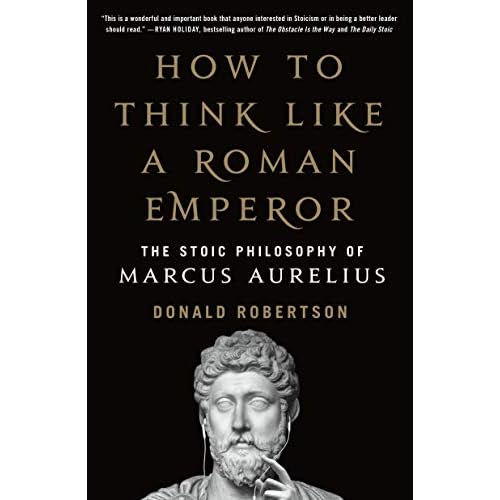
Donald Robertson
Marcus’s life told beside his ideas by a psychotherapist who links Stoicism to modern therapy. About 304 pages in this edition. Easier going than Hadot.
What is Marcus Aurelius' Meditations about?
It is a private notebook in which the emperor reminds himself of the ideas he wanted to live by: what is and is not in our control, the smallness of human affairs seen from above, the certainty of change and death, duty to the common good, and the value of the present moment.
Did Marcus Aurelius write the Meditations to be published?
No. He wrote in Greek for himself, addressing himself in the second person, and the title was added later. That is why the book has no introduction and repeats itself.
When was the Meditations written?
No firm year can be given. It belongs to the last decade or so of his life, before his death in 180 CE, and parts were written while he was on campaign on the Danube frontier.
Is the Meditations hard to read?
The sentences are short and in a good modern translation easy to follow. What makes it hard is the lack of structure and the repetition, so many readers dip in rather than read straight through.
Which translation of the Meditations is best for beginners?
Gregory Hays’s Modern Library translation is the plainest modern English and has a helpful introduction. Martin Hammond’s Penguin version is closer to the Greek, with more notes.
Is Marcus Aurelius the same as Epictetus?
No. Epictetus was a Stoic teacher and former slave whose sayings were recorded by Arrian; Marcus was an emperor who read him and drew many of his main ideas from him.
The Meditations reads best as one man's reminders, in a plain translation
Marcus Aurelius’ Meditations is not a system of philosophy or a manual but an emperor’s notes to himself, mostly Stoic and largely drawn from Epictetus. Its five recurring ideas, control, the view from above, death, the common good and the present moment, explain why it still finds readers. Start with a clear modern translation such as Gregory Hays’s, read Epictetus next, and keep Hadot for when you want to know how the notes hold together.