The 6 Best Logotherapy Books (Viktor Frankl & Beyond)
Logotherapy — Viktor Frankl’s “healing through meaning” — is the most famous branch of the existential tradition, and the easiest to enter through books. This list is part of our bigger guide to the best existential therapy books; here we rank the six logotherapy books worth your time, from the world-famous memoir to the clinical texts.
Frankl’s core claim is simple and radical: the primary human drive is not pleasure (Freud) or power (Adler) but meaning — and a person who has a “why” to live for can bear almost any “how.” If that idea resonates, start at #1 and read downward.
- Meaning is the primary drive Frankl’s core claim: humans are motivated by meaning more than pleasure or power — a “why” makes almost any “how” bearable.
- Start with the memoir Man’s Search for Meaning is the entry point; the clinical texts deepen it afterward.
- Still practiced today Meaning-centered therapy, heavily influenced by Frankl, is actively used in palliative and cancer care worldwide.
Independently researched and ranked by our editorial team. As an Amazon Associate, this site earns from qualifying purchases made through the links below.




#1: Man's Search for Meaning — START HERE
Viktor E. Frankl
Half concentration-camp memoir, half introduction to logotherapy, and one of the most influential books of the twentieth century. Short enough to read in an evening; most people reread it for life.
- First-person Holocaust testimony fused with a psychiatry of meaning — there is nothing else like it
- Short (about 165 pages); part one can be read in a single sitting and rarely lets go
- The core claim — a ‘why’ makes almost any ‘how’ bearable — has held up in palliative and trauma care
- The Beacon edition includes Frankl’s 1984 postscript on tragic optimism
- Verified buyers regularly complain the Beacon mass-market printing has small, tight type — pick the larger trade paperback if your eyes are older
- Part two, the logotherapy lecture, is far drier than the memoir; many readers stall there
- Light on method — it tells you meaning matters, not how a session works
#2: The Doctor and the Soul — THE THEORY
Viktor E. Frankl
Frankl’s systematic statement of logotherapy: meaning in work, in love, and in suffering, plus his signature techniques like paradoxical intention. The natural second book.
- Frankl’s fullest clinical statement — the medical book behind the memoir
- Dedicated chapters on the meaning of work, love, and suffering that MSFM only sketches
- Shows logotherapy applied to real diagnostic categories, not just extreme suffering
- Mid-century Viennese academic prose — formal, slow, and repetitive by modern standards
- The translation preserves the original’s dense structure; readers call it a study text, not a bedside one
- Case material is brief compared with what modern readers expect
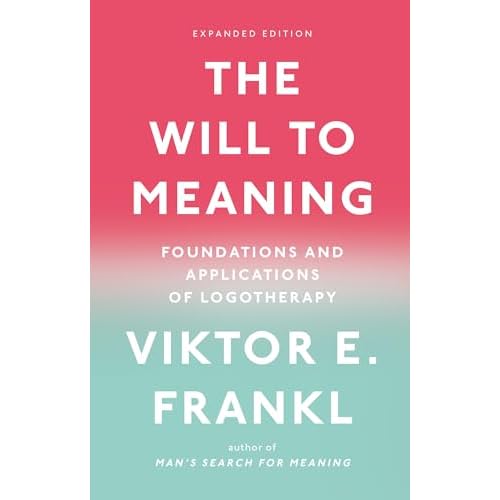
#3: The Will to Meaning — MOST CONCISE
Viktor E. Frankl
Compact lectures laying out logotherapy’s foundations and answering its critics. Clearer and more argumentative than the memoir — ideal for readers who want the ideas straight.
- The most systematic statement of logotherapy’s foundations and its answer to Freud and Adler
- Short — the theory without the 400-page commitment
- The 2014 Plume reissue is the easiest edition to find and read
- Assumes you have already read Man’s Search for Meaning
- Compiled partly from lectures, so key points repeat across chapters
- Abstract throughout — almost no extended case material
#4: Yes to Life: In Spite of Everything — HIDDEN GEM
Viktor E. Frankl
Rediscovered lectures Frankl gave months after liberation, published in English only in 2020. Raw, immediate, and deeply moving — the memoir’s ideas at the moment of their birth.
- Three lectures delivered in 1946, months after liberation — the historical immediacy is the point
- Short enough for one evening; the most accessible Frankl after MSFM
- Daniel Goleman’s introduction sets the historical context well
- Overlaps heavily with Man’s Search for Meaning — buyers often report half of it feels familiar
- These are transcribed lectures, looser and less polished than his written books
#5: Man's Search for Ultimate Meaning — Best for the spiritual dimension
Viktor E. Frankl
Frankl’s late exploration of the unconscious longing for transcendence. The most speculative book on this list — fascinating if you want logotherapy’s spiritual edge.
- Extends logotherapy into religion and the unconscious — the questions the other books avoid
- A late-career synthesis, with Frankl revisiting his own system after fifty years
- The chapter on the ‘unheard cry for meaning’ connects directly to modern meaning-centered therapy
- The most academic Frankl — general readers regularly describe it as heavy going
- It is a revision of the earlier The Unconscious God, and parts read recycled
- The weakest starting point in his catalog; keep it for last
#6: Prisoners of Our Thoughts — FOR WORK LIFE
Alex Pattakos
A practitioner’s translation of Frankl’s principles into working life — seven practical principles, endorsed by Frankl himself before his death. The most actionable book here.
- Applies Frankl’s principles to ordinary working life with concrete exercises
- Pattakos worked with Frankl directly, and the book carries the family institute’s endorsement
- The most actionable book in the logotherapy shelf — meaning as a workplace practice
- The business-book tone jars against the gravity of the source material
- Corporate examples date quickly and feel thin next to Frankl’s own cases
- Readers wanting Frankl’s voice should go to the primary texts first
How logotherapy fits the wider existential picture
Frankl addressed one of the four givens — meaninglessness — with unmatched force, but the full existential framework covers death, freedom, and isolation too. For that broader map, see The Four Givens Explained and our overview What Is Existential Therapy?. Yalom’s Existential Psychotherapy devotes a major section to meaning and engages Frankl directly.
How to choose a Frankl book
- Reading order
Frankl’s catalog is one memoir plus a ring of clinical and philosophical expansions.
Look forMan's Search for Meaning first — everything else assumes itAvoidStarting with Ultimate Meaning or The Will to Meaning cold - Edition and print size
The bestselling Beacon mass-market of MSFM is also its most complained-about printing.
Look forThe Beacon trade paperback or hardcover if small type bothers youAvoidThe pocket edition for older eyes or gift copies - Testimony versus clinic
Half his books are lived witness, half are Viennese lecture hall — the tone gap is real.
Look forYes to Life for more testimony; Doctor and the Soul for the clinicAvoidExpecting the memoir's grip from the theoretical works
What order should I read Frankl in?
Man’s Search for Meaning first, always. Then The Doctor and the Soul if you want the clinical theory, or Yes to Life if you want another short, moving read.
Is logotherapy still practiced today?
Yes. Meaning-centered therapy, heavily influenced by Frankl, is actively used — notably in palliative and cancer care — and institutes teaching logotherapy operate worldwide.
Bottom line
Logotherapy’s core claim — that meaning is the primary human motivation — has aged remarkably well. Start with Man’s Search for Meaning; everything else builds on it.