The Best Stoicism Books: 10 Picks from Marcus Aurelius to Modern Practice
Stoicism survived two thousand years because it works under pressure — exile, illness, empire, inbox. These ten books run from the three ancient sources to the modern manuals, ranked honestly, with guidance on which translation to buy and which hype to skip.
The best Stoicism book is Marcus Aurelius’s Meditations in the Gregory Hays translation — the emperor’s private notebook and the school’s most direct text. Seneca’s Letters from a Stoic is the warmest entry point, while William Irvine’s A Guide to the Good Life is the strongest modern bridge from ancient text to daily practice.
- Three ancients, then bridges Marcus, Seneca, and Epictetus are the sources; everything modern is commentary — read at least one source first.
- Translation is the purchase With ancient texts the translator is the book — Hays’s Meditations reads a century younger than the free public-domain versions.
- Practice beats quotation The Stoics prescribed exercises, not mottos — the best modern books restore that practice layer.
This guide belongs to our books on the meaning of life silo — Stoicism is the branch of that question built for bad weather.
What Stoicism actually teaches (beyond the memes)
The whole school stands on one distinction: some things are up to us — our judgments, intentions, and responses — and everything else is not. Epictetus put it bluntest; Marcus practiced it nightly in a war camp; Seneca dressed it in style. From that single hinge come the famous exercises: rehearsing loss before it arrives, reviewing the day each evening, meeting insult with curiosity about your own reaction.
Two corrections to the internet version. Stoicism is not the suppression of feeling — it is the training of judgment so that feeling has better material to work with. And it is not a productivity hack; it is a philosophy of death, built by people who expected exile and got it. Readers of this site will recognize the territory: the Stoics and the existential therapists are working the same four givens from different centuries. It is no accident that Albert Ellis and Aaron Beck both named Epictetus as an ancestor of cognitive therapy.
Where to start, and in which translation
Start with Meditations — but insist on the Gregory Hays translation, because with a two-thousand-year-old text the translator is most of your purchase. Free e-book versions from the 1800s have filtered out more would-be Stoics than any argument ever did. Then choose your second ancient by temperament: Seneca’s letters if you want warmth and wit, Epictetus if you want the stern, unpadded version.
The moderns divide by job. Irvine’s A Guide to the Good Life is the best single synthesis of the practices; Robertson’s How to Think Like a Roman Emperor is the pick if you come from therapy or psychology, since he draws the Stoicism-to-CBT line explicitly. Holiday’s books are the wide front door — walk through them to the sources rather than stopping in the doorway.
Independently researched and ranked by our editorial team. As an Amazon Associate, this site earns from qualifying purchases made through the links below.




#1: Meditations — Best overall
Marcus Aurelius (tr. Gregory Hays)
The emperor’s private notes to himself, in the translation that made them read like living speech. Fragmentary, repetitive, and inexhaustible — the desert-island Stoic book.
- The Gregory Hays translation reads as living speech, not museum prose
- Private notebook honesty — Marcus never wrote it for publication
- Endlessly re-readable in fragments; a page at breakfast is a real practice
- The central primary text of Stoicism, needing no prior context
- Repetitive by design — it was a self-reminder journal, not an argument
- No structure to follow; readers wanting a system should pair it with a modern guide
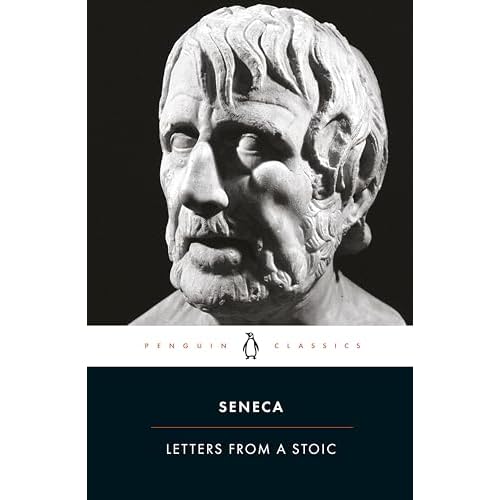
#2: Letters from a Stoic — Warmest entry point
Seneca
Moral letters from Rome’s most worldly philosopher — on time, friendship, grief, and dying well. Witty, personal, and compromised in ways that make the wisdom more human, not less.
- Seneca is the most readable of the Stoics — witty, worldly, personal
- Self-contained letters make ideal daily reading
- Covers friendship, grief, time, wealth, and dying well in one volume
- The Penguin selection is well curated for first-time readers
- Seneca’s enormous wealth and imperial politics complicate the preaching
- A selection, not the complete letters — completists will want more
#3: On the Shortness of Life — Best single essay
Seneca
Ninety pages arguing that life is long if you know how to use it — the sharpest thing ever written about busyness, composed two thousand years before email.
- The single best essay on time ever written, in any century
- Under a hundred pages — readable in one evening
- Startlingly modern on busyness, distraction, and postponed living
- The Great Ideas edition is bare-bones, with no notes or introduction
- The two companion essays included are weaker than the title piece
#4: Discourses and Selected Writings — The sternest teacher
Epictetus
Classroom transcripts from the ex-slave who taught Rome its philosophy — the dichotomy of control in its original, bluntest form, and the source text behind modern CBT.
- Epictetus is the sternest, clearest Stoic teacher — no ornament, all instruction
- The dichotomy of control originates here, in its original blunt form
- Classroom transcripts — direct, spoken, and alive
- The acknowledged ancestor text of cognitive behavioral therapy
- Repetitive and unpolished, as lecture transcripts inevitably are
- Harsher in tone than Seneca or Marcus — some readers bounce off
#5: A Guide to the Good Life — Best modern synthesis
William B. Irvine
A philosophy professor rebuilds Stoicism as a coherent modern life plan — negative visualization, voluntary discomfort, and honest notes on where he departs from the ancients.
- The best modern synthesis of Stoic practice as a coherent life plan
- Negative visualization explained better than anywhere else
- Honest about where his version updates or departs from the ancients
- Scholars dispute some of Irvine’s adaptations, notably his take on the dichotomy of control
- Drier prose than the ancient sources he’s introducing
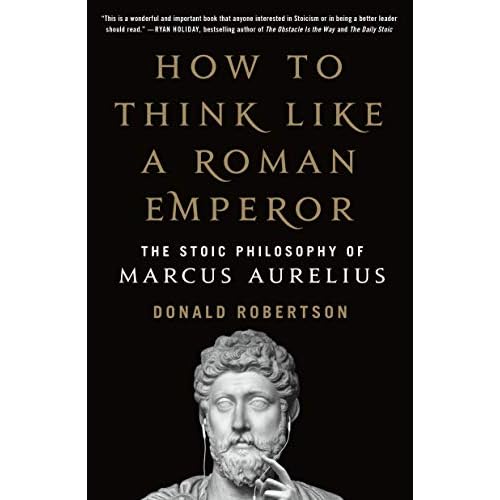
#6: How to Think Like a Roman Emperor — Best Stoicism-CBT bridge
Donald Robertson
A cognitive-behavioral therapist reads Marcus Aurelius as biography and clinical manual at once — the book that makes the Stoicism-to-CBT lineage explicit and usable.
- Written by a cognitive-behavioral therapist — the Stoicism-CBT bridge made explicit
- Biography of Marcus Aurelius and practice manual in one
- Exercises grounded in actual clinical technique, not vibes
- The biographical frame occasionally slows the instruction
- Overlaps heavily with Irvine if you own both modern guides
#7: The Daily Stoic — Best daily habit
Ryan Holiday & Stephen Hanselman
366 meditations, each pairing a Stoic passage with brief commentary — shallow by design and effective for the same reason. The lowest-friction way to keep the school in your week.
- 366 daily meditations — the lowest-friction Stoic habit in print
- Each page pairs a well-chosen ancient passage with brief commentary
- The ideal gift format; opens anywhere, demands nothing
- Necessarily shallow — a page a day cannot make an argument
- Holiday’s business-world framing isn’t for everyone
How to choose a Stoicism book
-
Source or commentary
Ancient texts and modern guides do different jobs.
Look forAt least one primary source — Meditations or the Letters — before any modern manual.AvoidBuilding your Stoicism entirely from quotations and secondhand summaries. -
Translation quality
Public-domain versions cost nothing and read like it.
Look forHays for Marcus, the Campbell Penguin selection for Seneca, the Penguin Discourses for Epictetus.AvoidFree 19th-century e-book translations — they've filtered out more readers than they've converted. -
Practice layer
Stoicism is a set of exercises, not an aesthetic.
Look forBooks that assign something — evening review, negative visualization, journaling.AvoidMistaking a quote calendar for a philosophy of life.
How we chose these books
-
Firsthand reading
Rankings start from our editors’ full reads of every title on the list — including the slow middles and the failed first attempts — not from publisher copy.
-
Reader-review analysis
We mined verified-purchase reviews, Goodreads consensus, and Reddit reading threads for recurring, specific complaints: print size, abridgments, translation quality, abandonment points.
-
Edition comparison
Where multiple translations or editions exist, we compared them and linked the printing most readers should actually buy — and flagged the known trade-offs.
What is the best book on Stoicism for beginners?
Marcus Aurelius’s Meditations in the Gregory Hays translation — short, direct, and the school’s heart, needing no prior context. If you’d rather have a modern on-ramp first, William Irvine’s A Guide to the Good Life explains the practices before you meet the ancient voices.
Should I read Marcus Aurelius, Seneca, or Epictetus first?
Meditations for most readers. Choose Seneca’s letters if you prefer warmth and wit, Epictetus if you want the sternest, clearest version of the dichotomy of control. All three primary texts together fit comfortably in one season of reading.
Is Stoicism connected to modern therapy?
Directly. Albert Ellis and Aaron Beck both credited the Stoics — especially Epictetus’s line that people are disturbed not by things but by their judgments of things — as ancestors of cognitive behavioral therapy. Donald Robertson’s How to Think Like a Roman Emperor maps the lineage in full.
Is Ryan Holiday's version of Stoicism accurate?
It’s a sincere popularization — accurate in outline, thinner in philosophy. The Daily Stoic and The Obstacle Is the Way work well as doors and habit-builders; the mistake is stopping in the doorway instead of walking through to Marcus, Seneca, and Epictetus.
Bottom line
Marcus, Seneca, and Epictetus are the school; Irvine and Robertson are the best bridges; Holiday is the door and the daily habit. Buy the Hays translation, read one page at breakfast, and you’re already practicing.