The 10 Best Books About Death and Dying
Books about death divide into three honest lanes: what medicine does at the end, what dying feels like from inside, and what mortality means for how we live now. These ten cover all three — ranked, with real flaws noted.
The best books about death and dying are Atul Gawande’s Being Mortal for end-of-life medicine, Irvin Yalom’s Staring at the Sun for confronting death anxiety, and Paul Kalanithi’s When Breath Becomes Air as memoir. Ernest Becker’s The Denial of Death remains the philosophical landmark.
- Three lanes Medicine (Gawande, Nuland), memoir (Kalanithi, Didion), and meaning (Yalom, Becker, Frankl) — know which you need.
- Death anxiety is workable Yalom’s core claim: confronting mortality directly tends to make life more vivid, not darker.
- Timing matters The graphic clinical books serve the curious well and the freshly bereaved badly — sequence accordingly.
This guide belongs to our best books on the meaning of life silo — because in the existential tradition, death and meaning are one subject.
Why read about death at all?
Yalom’s answer, drawn from decades with dying patients: death anxiety never disappears by being ignored — it leaks into symptoms that look like anything but. Confronted directly, it does something unexpected. His hospice patients repeatedly described a paradox: physically diminished, they felt more alive, more honest, less afraid of trivia. He calls death “the condition that makes it possible to live authentically.”
The research agrees more than you’d expect. Structured mortality reflection — the kind these books produce — correlates with clearer priorities and reduced death anxiety over time, which is the entire premise of meaning-centered therapies used in palliative care.
Memoir, medicine, or philosophy — choosing your lane
If someone you love is in decline, start with Being Mortal — it is the book most likely to change actual decisions about care. If death has turned abstractly frightening, Staring at the Sun speaks to that directly. If you want the view from inside, Kalanithi and Didion are the two essential memoirs — one written while dying, one written while grieving.
The philosophy shelf — Becker, Frankl — rewards readers who want the full argument beneath the comfort. Becker especially is a commitment; read him last, not first.
Independently researched and ranked by our editorial team. As an Amazon Associate, this site earns from qualifying purchases made through the links below.
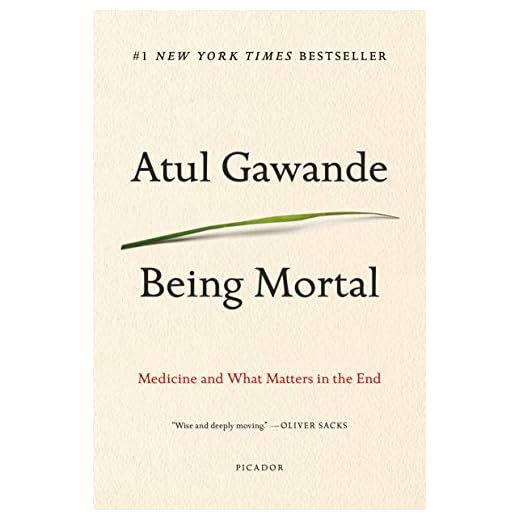



#1: Being Mortal — Best overall
Atul Gawande
A surgeon’s reckoning with what medicine gets wrong about aging and dying — and the questions that put a person’s own priorities back in charge. The most practically useful book on this list.
- Reframes end-of-life medicine around the person’s own priorities rather than survival at any cost
- The history of nursing homes and assisted living is genuinely eye-opening
- Gawande’s account of his father’s decline and death is the book’s clinical and emotional core
- Stronger on diagnosis than prescription — the ‘what to do instead’ chapters are thinner
- Heavily centered on the US healthcare system
#2: Staring at the Sun — Best on death anxiety
Irvin D. Yalom
Yalom’s direct manual for confronting mortality, built on the ‘rippling’ idea — the influence we leave in others outlives us. Warm, practical, and drawn from real cases.
- The most direct treatment of death anxiety written for general readers, not clinicians
- The ‘rippling’ idea — living on through your effect on others — is the concept readers most often single out as consoling without religion
- Short and plainly written; blends memoir, case material, and philosophy
- Yalom writes it in his mid-seventies, facing the subject himself — the honesty shows
- Readers of Existential Psychotherapy will recognize recycled material and case stories
- Some case dialogues feel condensed and a little too neatly resolved
- The hardback layout pads a modest text; it is a shorter book than it looks
#3: Man's Search for Meaning — The classic
Viktor E. Frankl
Frankl’s Holocaust memoir and the birth of logotherapy in one short book. The single most recommended title on suffering and meaning ever written.
- First-person Holocaust testimony fused with a psychiatry of meaning — there is nothing else like it
- Short (about 165 pages); part one can be read in a single sitting and rarely lets go
- The core claim — a ‘why’ makes almost any ‘how’ bearable — has held up in palliative and trauma care
- The Beacon edition includes Frankl’s 1984 postscript on tragic optimism
- Verified buyers regularly complain the Beacon mass-market printing has small, tight type — pick the larger trade paperback if your eyes are older
- Part two, the logotherapy lecture, is far drier than the memoir; many readers stall there
- Light on method — it tells you meaning matters, not how a session works
#4: When Breath Becomes Air — Best memoir
Paul Kalanithi
A 36-year-old neurosurgeon writes his way through his own lung-cancer death. Unfinished by nature, extraordinary in fact — the epilogue by his wife is the strongest chapter.
- Written by a neurosurgeon while he was dying of lung cancer — no other book has this vantage point
- Kalanithi held a literature MA before medicine, and the prose shows it
- His wife Lucy’s epilogue, describing his death, is the strongest chapter in the book
- Unfinished by nature — it ends abruptly, because he died
- The Stanford-perfection arc distances some readers before the illness narrative begins
#5: The Year of Magical Thinking — Best on grief
Joan Didion
Didion’s National Book Award account of the year after her husband died mid-sentence at dinner. The most precise description of grief’s magical thinking in print.
- Grief observed in real time with a reporter’s precision — the ‘magical thinking’ of keeping his shoes because he’ll need them
- Named a universal experience that had no name; grief clinicians assign it for that reason
- Won the National Book Award; the prose control is the point — grief inside a controlled mind
- That same cool control reads as detached to some grieving readers looking for warmth
- The Manhattan literary milieu — private clubs, Malibu — can distance readers
#6: The Denial of Death — The deep end
Ernest Becker
The Pulitzer-winning argument that character itself is a defense against mortality — the intellectual backbone behind Yalom’s death work and terror management theory.
- The 1974 Pulitzer winner that underpins Yalom’s death chapters and the whole of terror management theory
- A genuine synthesis — Kierkegaard, Freud, and Otto Rank braided into one argument about heroism
- The core idea (character as a defense against mortality) reorganizes how you read everything else on this list
- Far harder going than its fame suggests — dense, academic, psychoanalytic prose
- The second half assumes real familiarity with Rank and Kierkegaard, and some clinical claims are badly dated
How to choose a book about death and dying
-
Your situationThe right book depends on whether death is near, past, or abstract for you right now.Look forBeing Mortal for active decisions; Didion for grief; Yalom for anxiety about your own mortality.AvoidHow We Die or graphic clinical detail during fresh bereavement.
-
Comfort vs truthSome books console; others inform. The best do both, but every book leans one way.Look forHonest acknowledgment of what medicine and philosophy cannot fix.AvoidBooks promising to eliminate the fear of death — the serious literature never does.
-
Depth commitmentThis list spans a two-hour memoir and a dense Pulitzer-winning monograph.Look forKalanithi or Doughty for a weekend; Becker only after the accessible books.AvoidStarting with The Denial of Death — it is the deep end, not the door.
How we chose these books
-
Firsthand reading
Rankings start from our editors’ full reads of every title on the list — including the slow middles and the failed first attempts — not from publisher copy.
-
Reader-review analysis
We mined verified-purchase reviews, Goodreads consensus, and Reddit reading threads for recurring, specific complaints: print size, abridgments, translation quality, abandonment points.
-
Edition comparison
Where multiple translations or editions exist, we compared them and linked the printing most readers should actually buy — and flagged the known trade-offs.
What is the best book about death and dying?
For most readers, Atul Gawande’s Being Mortal — it is rigorous, humane, and changes real decisions about end-of-life care. For fear of death specifically, Irvin Yalom’s Staring at the Sun is the standard recommendation.
Are the five stages of grief real?
Not as a fixed sequence. Kübler-Ross described the stages from interviews with dying patients, not the bereaved, and modern grief research finds no orderly progression. Current clinicians treat them as possible experiences, not steps.
Does reading about death make anxiety worse?
Usually the opposite, when done deliberately. Existential therapists including Yalom report that direct engagement with mortality tends to reduce death anxiety and sharpen priorities — avoidance is what keeps the fear loud.
What should I read after Being Mortal?
Staring at the Sun if the interest is psychological, When Breath Becomes Air if you want memoir, or The Denial of Death if you want the full philosophical argument.
Bottom line
Being Mortal for decisions, Staring at the Sun for the fear, Kalanithi and Didion for the inside view, Becker for the theory. Death books work best in sequence — accessible first, deep end last.