Hermann Hesse Books in Order: From Siddhartha to The Glass Bead Game
Hesse wrote one story his whole life — a divided self seeking wholeness — and told it at every scale from fable to thousand-page final masterpiece. He was also psychoanalysis's novelist: a patient of Jung's circle whose books turned the therapy into fiction. Here's the order that lets the story build.
Read Hermann Hesse in this order: Siddhartha first — short, luminous, and complete in itself — then Demian, Steppenwolf, and Narcissus and Goldmund, finishing with The Glass Bead Game, the Nobel-cited summit. Every Hesse novel tells the same quest differently: a self seeking its own depths.
- One quest, many costumes Every major Hesse novel is the same search for the undivided self — read in order, they form a single ascending argument.
- Psychoanalysis in fiction Hesse underwent analysis with Jung’s associate J.B. Lang (and met Jung himself) — Demian and Steppenwolf are individuation rendered as story.
- Save the summit The Glass Bead Game assumes you know the earlier books — it’s the final exam, not the entrance.
This path is part of our existentialism for readers silo — Hesse is the bridge between that shelf and the psychology of individuation.
The novelist of the divided self
Hesse’s crisis years were psychoanalytic: dozens of sessions with Josef Lang, a student of Jung, during the breakdown that produced Demian — and the novels afterward read like individuation taught by parable. The mark of Cain reframed as election, the wolf and the burgher sharing one skin, the monk and the wanderer as halves of a whole: these are Jungian polarities given names and plots.
That is why psychologically minded readers keep him close. Where Dostoevsky maps guilt and faith, Hesse maps integration — the lifelong work of making the warring selves into one. Readers of this site will recognize the project: it is the novelistic cousin of the self-exploration shelf, and the reason Siddhartha keeps appearing on lists beside formal psychology.
The reading order, and why it works
Start with Siddhartha — a hundred luminous pages, complete in themselves, and the purest statement of the quest. Demian follows as the psychological deepening: shorter and stranger than its reputation, and the template for every coming-of-age-into-depth novel since. Then Steppenwolf, the midlife book — best read when the reader has a midlife to bring to it.
Narcissus and Goldmund is the warmest of the majors — the thinker and the artist walking the polarity at full length — and the right rest before the climb. Journey to the East is a short, dreamlike key that unlocks the finale: The Glass Bead Game, the Nobel-cited masterwork where the life of the mind finally questions itself. Two early novels — Beneath the Wheel and Peter Camenzind — are for completists circling back.
Independently researched and ranked by our editorial team. As an Amazon Associate, this site earns from qualifying purchases made through the links below.




#1: Siddhartha — Start here
Hermann Hesse
The quest novel at its purest — a hundred pages that follow one seeker past every teacher, including the Buddha, to the river where wisdom finally can’t be taught. Complete in itself.
- The gentle door into meaning-fiction — a life spent trying every answer: asceticism, pleasure, commerce, despair, the river
- Hesse’s clean parable prose survives translation better than almost any novel here
- The ferryman ending earns its peace honestly — striving exhausted before wisdom arrives
- Ideal gift and reread book; it changes as the reader ages
- A Westerner’s 1922 rendering of Indian thought — read as Hesse, not as Buddhism
- The parable style can feel simple to readers wanting psychological granularity
- Its counterculture-era fame buried it under incense associations it doesn’t deserve
#2: Demian — The psychological door
Hermann Hesse
A boy’s initiation into his own depths, written straight out of Hesse’s psychoanalysis — short, gripping, and the template for a century of novels about becoming yourself.
- The ideal first Hesse after Siddhartha — short, gripping, and mysterious
- The template of the Jungian coming-of-age novel
- Its reframing of the mark of Cain still startles a century on
- The mystical machinery creaks in the final war-time chapters
- The young narrator’s intensity can read as overwrought to older readers
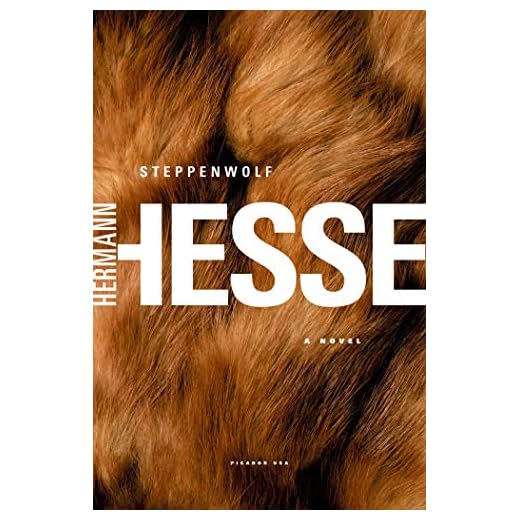
#3: Steppenwolf — The midlife novel
Hermann Hesse
The wolf and the man in one body — Hesse’s darkest major novel, crowned by the hallucinatory Magic Theater. Famously misread by the counterculture; better read as what it is: a crisis survived.
- The midlife-crisis novel of world literature
- The Magic Theater sequence is one of the strangest, most memorable set pieces in the canon
- Harry Haller’s divided self maps Jungian psychology directly onto fiction
- Famously misread as counterculture endorsement — Hesse himself protested
- Structurally odd: treatise inside novel inside found manuscript
#4: Narcissus and Goldmund — The warmest major
Hermann Hesse
The monk and the wanderer — mind versus senses walked through a medieval world with fairy-tale timelessness. Many lifelong readers’ favorite Hesse.
- The thinker and the artist — Hesse’s great polarity given its fullest story
- The medieval setting lends it fairy-tale timelessness
- Many lifelong readers’ favorite Hesse
- The episodic wandering middle loses some readers
- Its portrayal of women is very much of its era
#5: Journey to the East — The strange key
Hermann Hesse
A brief, dreamlike pilgrimage fable whose servant-as-leader twist seeded a whole leadership literature — minor Hesse that quietly opens the door to the Glass Bead Game.
- A short late fable that prefigures The Glass Bead Game’s League
- The servant-as-true-leader twist later seeded an entire leadership literature
- Dreamlike compression — a novella that reads like a remembered dream
- Opaque on first reading; it rewards a second pass
- The thinnest of his books considered purely as a novel
#6: The Glass Bead Game — The summit — read last
Hermann Hesse
His final novel and Nobel-cited masterwork — an invented intellectual civilization and the life of the mind questioned by its own most beautiful game. Slow, formal, and worth every prior book.
- The Nobel-cited masterwork and his final novel
- An entire invented intellectual civilization, rendered whole
- The deepest statement of every theme he ever worked
- Slow, formal, and long — read the earlier novels first to earn it
- The framing device holds emotion at a deliberate distance
How to read Hesse well
-
Order and life-stageHesse's novels meet readers at particular ages.Look forSiddhartha and Demian young or old; Steppenwolf with some life behind you; the Glass Bead Game last.AvoidJudging Hesse by Steppenwolf at nineteen — it's the book most often read at exactly the wrong time.
-
Translation and editionMost Hesse in English is decades old and varies by publisher.Look forThe standard Picador/FSG editions; newer translations of Siddhartha and Demian where available.AvoidBargain editions of Siddhartha with stiff, public-domain-adjacent prose — the music is the point.
-
DoseHesse's intensity compounds — the quest can blur if binged.Look forOne Hesse, then something else, then the next — the books land harder with air between them.AvoidReading all six majors consecutively; by the fourth, every river starts to sound the same.
How we chose these books
-
Firsthand reading
Rankings start from our editors’ full reads of every title on the list — including the slow middles and the failed first attempts — not from publisher copy.
-
Reader-review analysis
We mined verified-purchase reviews, Goodreads consensus, and Reddit reading threads for recurring, specific complaints: print size, abridgments, translation quality, abandonment points.
-
Edition comparison
Where multiple translations or editions exist, we compared them and linked the printing most readers should actually buy — and flagged the known trade-offs.
Which Hermann Hesse book should I read first?
Siddhartha — a hundred pages, complete in itself, and the purest expression of the search that runs through everything he wrote. Demian is the strongest second: shorter, stranger, and the psychological deepening of the same quest.
What order should I read Hermann Hesse's books in?
Siddhartha, then Demian, Steppenwolf, and Narcissus and Goldmund, with Journey to the East as the short key before The Glass Bead Game — the Nobel-cited summit that assumes you know the earlier books. Beneath the Wheel and Peter Camenzind are for completists.
Is Hermann Hesse connected to psychology?
Deeply. Hesse underwent psychoanalysis with J.B. Lang, a student of Jung, during the crisis that produced Demian, and later sat with Jung himself. Demian and Steppenwolf are widely read as individuation — Jung’s central process — rendered as fiction.
Is Steppenwolf a good first Hesse?
Usually not. It’s the midlife book — a crisis novel that lands hardest on readers with some life behind them — and it’s structurally the strangest of the majors. Read Siddhartha and Demian first; Steppenwolf will be waiting, and better, later.
Bottom line
Siddhartha opens the quest, Demian deepens it, Steppenwolf survives it, and The Glass Bead Game completes it. Read them in order, spaced apart, and Hesse’s one lifelong story assembles itself — the divided self, walked all the way home.