Rollo May Books: A Reading Guide to the American Existentialist
Rollo May carried European existentialism into American psychology — and directly into Irvin Yalom's work, since May was Yalom's own therapist for a time. Here is the reading order that makes his five essential books add up.
Start Rollo May with Man’s Search for Himself (1953), his most readable book. Move to The Courage to Create, then his major work Love and Will (1969). The Discovery of Being summarizes his existential psychology; The Meaning of Anxiety is the scholarly foundation.
- Yalom's own therapist May treated Yalom during his internship years — the intellectual line from May to Existential Psychotherapy is direct and acknowledged.
- Start easy, climb Man’s Search for Himself first, Love and Will only after — his major work is also his densest.
- Anxiety reframed May’s signature move: anxiety as the ‘dizziness of freedom’ and a signal of growth, not merely a symptom to remove.
This guide is part of our great minds of psychology series on the thinkers behind existential therapy.
Who was Rollo May?
Rollo May (1909–1994) did for American psychology what the translators never quite managed: he made Kierkegaard and Heidegger clinically usable. Trained in theology under Paul Tillich before psychology, he treated anxiety, will, and love as the proper subjects of therapy at a time when behaviorism ruled the field.
The connection to this site is personal: May was Irvin Yalom’s therapist during a difficult period, and Yalom has written openly about the debt. Read May and you are reading the headwaters of Existential Psychotherapy.
The right reading order
Not publication order. Man’s Search for Himself (1953) is the accessible statement of everything — emptiness, loneliness, the courage to be a self — and should come first. The Courage to Create is the short, giftable second step. Then the summit: Love and Will (1969), his bestseller and his hardest.
Save The Discovery of Being for when you want the theory stated plainly, and The Meaning of Anxiety — his reworked dissertation — for when you want the scholarly roots. Skipping straight to Love and Will is the classic mistake; half its readers stall by chapter three.
Independently researched and ranked by our editorial team. As an Amazon Associate, this site earns from qualifying purchases made through the links below.
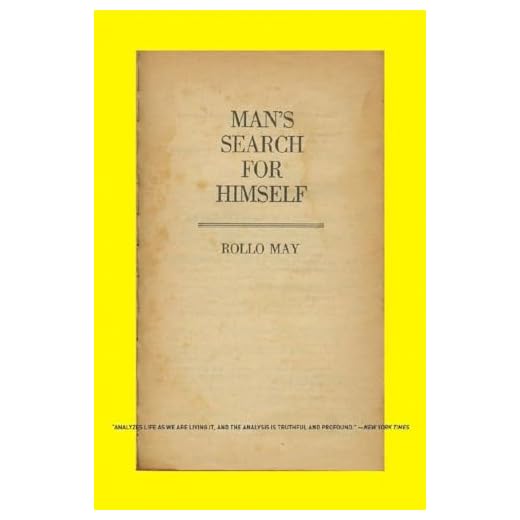


#1: Man's Search for Himself — Start here
Rollo May
Anxiety, loneliness, and the ‘hollow people’ of modern life, in May’s most readable prose. Seventy years old and uncomfortably current.
- May’s most readable book — anxiety, loneliness, and emptiness in plain mid-century prose
- The ‘hollow people’ diagnosis of modern emptiness anticipated the culture-of-narcissism critiques by decades
- Practical chapters on selfhood and courage that general readers can actually use
- 1953 references and gender assumptions date whole passages
- The middle chapters circle the same argument more than once
#2: Love and Will — The major work
Rollo May
Eros, the daimonic, and intentionality — May’s 1969 bestseller and his deepest book. The densest May by far; climb the easier books first.
- May’s major work — eros, the daimonic, and intentionality — and a genuine 1969 bestseller
- The daimonic concept (the power that can possess or be integrated) is his most original contribution
- The reading of care as the source of will still anchors existential therapy training
- The densest May by far — parts are near-academic and the Greek terminology piles up
- The 1969 sexual politics require historical allowance
#3: The Courage to Create — Most giftable
Rollo May
A hundred-odd pages arguing that creativity is an act of courage, not talent — readable in an evening, rereadable for years.
- Short lecture-based book arguing creativity is an act of courage, not talent
- The ‘encounter’ concept — full engagement with the work — is useful to artists and therapists alike
- Readable in an evening; many readers reread it yearly
- Its lecture origins show — the structure is loose and the chapters uneven
- Light on practical method; it inspires rather than instructs
#4: The Discovery of Being — The theory
Rollo May
The clearest short statement of existential psychology May ever wrote — the bridge between European phenomenology and the American consulting room.
- The clearest short statement of existential psychology’s foundations May ever wrote
- Bridges European phenomenology and American consulting-room practice in under 200 pages
- The chapters on ‘being-in-the-world’ decode the jargon Yalom’s readers meet elsewhere
- Assembled from essays, so key ideas repeat across chapters
- Abstract throughout — readers wanting case stories should go to Yalom instead
#5: The Meaning of Anxiety — The foundation
Rollo May
The first major American work to treat anxiety as meaningful signal rather than symptom — Kierkegaard’s ‘dizziness of freedom’ grounded in clinical cases.
- The first major American work to treat anxiety as meaningful signal rather than mere symptom
- Grounds Kierkegaard’s ‘dizziness of freedom’ in actual clinical case studies
- The revised 1977 edition adds three decades of perspective to the original dissertation
- Its dissertation origins show — the literature-review chapters are a slog
- The empirical material is dated on both editions’ terms
How to choose your first Rollo May book
-
Difficulty honestyMay ranges from evening-read essays to near-academic density.Look forMan's Search for Himself or The Courage to Create as entry points.AvoidLove and Will first — it is the summit, not the trailhead.
-
Your angle inCreativity, anxiety, or the full existential system — May wrote for each.Look forCourage to Create for makers; Meaning of Anxiety for clinicians; Discovery of Being for theory.AvoidThe dissertation-based Meaning of Anxiety if you want smooth prose.
-
EditionNorton reissued the core May titles in uniform paperbacks.Look forThe current W.W. Norton paperback editions linked here.AvoidPrint-on-demand copies of the older editions — quality complaints are common.
How we chose these books
-
Firsthand reading
Rankings start from our editors’ full reads of every title on the list — including the slow middles and the failed first attempts — not from publisher copy.
-
Reader-review analysis
We mined verified-purchase reviews, Goodreads consensus, and Reddit reading threads for recurring, specific complaints: print size, abridgments, translation quality, abandonment points.
-
Edition comparison
Where multiple translations or editions exist, we compared them and linked the printing most readers should actually buy — and flagged the known trade-offs.
Which Rollo May book should I read first?
Man’s Search for Himself (1953) — it is his most readable book and states his core themes of anxiety, loneliness, and selfhood in plain language. Love and Will is the major work, but it rewards readers who arrive prepared.
What is Rollo May known for?
Bringing European existentialism into American psychology: anxiety as the ‘dizziness of freedom,’ the daimonic, and the existential approach that Irvin Yalom later systematized. He also personally influenced Yalom as his therapist.
Was Rollo May Irvin Yalom's therapist?
Yes — Yalom saw May for therapy and has written about the relationship openly. May’s ideas are foundational to Yalom’s Existential Psychotherapy, making May essential background for Yalom readers.
Is Love and Will worth reading today?
Yes, with preparation. Its treatment of eros, the daimonic, and intentionality remains May’s deepest contribution — but its density and 1969 sexual politics mean it works best as your third May book, not your first.
Bottom line
Man’s Search for Himself, then The Courage to Create, then Love and Will — with Discovery of Being and Meaning of Anxiety for the theory-minded. May is the bridge from Kierkegaard to Yalom; read him as the missing middle.