The Best Brené Brown Books: Where to Start and What Each One Teaches
Brené Brown turned two decades of shame research into a publishing empire — and the books genuinely differ. Some are research delivered warm, some are the same TED talk refilled. Here are all seven ranked, what each one actually adds, and the honest reading order.
The best Brené Brown book is Daring Greatly — the fullest statement of her vulnerability research and the one to read if you read only one. Start with The Gifts of Imperfection if you want the shorter, warmer entry, and Dare to Lead if you’re coming for the workplace application.
- One thesis, many angles Vulnerability is the price of connection and shame is what keeps us from paying it — each book turns that core a different direction.
- Grounded theory, delivered warm Brown is a qualitative researcher; her claims come from thousands of interviews — sturdier than most self-help, softer than clinical trials.
- Two books do most of the work Daring Greatly plus Atlas of the Heart covers the theory and the vocabulary — the rest deepen specific corners.
This guide is part of our psychology books to understand yourself silo — Brown’s shame research is the most accessible door into the self-understanding work this silo maps.
What the research actually says (and how solid it is)
Brown’s method is grounded theory: thousands of interviews coded for patterns, built into frameworks like the shame resilience theory that made her academic name. Her central findings — that shame corrodes and vulnerability connects, that the people she calls wholehearted share measurable practices — are qualitative research, not randomized trials. That makes her sturdier than the average self-help author by a wide margin, and softer than the CBT literature; fair readers hold both facts.
The core distinction worth the price of any of her books: guilt says I did something bad, shame says I am bad — and the research consistently finds guilt adaptive and shame destructive. Readers of this site will hear the existential echo: her “arena” is the risk of being truly seen, and the armor she catalogs — perfectionism, numbing, cynicism — are what a Yalom reader would call defenses against exposure.
The honest reading order
Read Daring Greatly first if you want the full argument — it is the most complete statement of the vulnerability research and the book her later work assumes. Read The Gifts of Imperfection first if you want the warmer, shorter door: ten guideposts for “wholehearted living,” and the book that helps most in an actually hard season. Either way, add Atlas of the Heart second — its map of eighty-seven emotions upgrades the vocabulary every other book relies on.
Then choose by need. Rising Strong is the failure-recovery book — what to do after the arena knocks you down — and quietly her most practical. Dare to Lead repackages the research for teams and managers; if you’ve read the others, skim for the tools. Braving the Wilderness on belonging is slighter but timely; I Thought It Was Just Me is the early, rawer shame book for completists tracing the research to its source.
Independently researched and ranked by our editorial team. As an Amazon Associate, this site earns from qualifying purchases made through the links below.
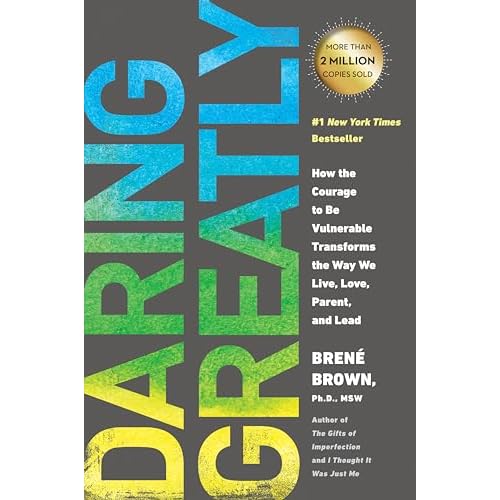


#1: Daring Greatly — Best overall
Brené Brown
The fullest statement of her research: vulnerability as courage, shame as the barrier, and the armory of defenses we mistake for strength. If you read one Brown, read this.
- The central statement — vulnerability reframed as courage rather than weakness
- Grounded in her grounded-theory research on shame
- The Roosevelt ‘arena’ frame has entered the language
- Qualitative research is presented with more certainty than method warrants
- Concepts repeat across her books; this one overlaps both neighbors
#2: The Gifts of Imperfection — Best starting point
Brené Brown
Ten guideposts for wholehearted living — letting go of perfectionism, numbing, and comparison. The book to hand someone in a hard season; small enough to finish, true enough to keep.
- The tightest and most practical of her books — ten guideposts, 130 pages
- Wholehearted living operationalized into daily practices
- The best single gift-book in her catalog
- Aphoristic; readers wanting the research go to Daring Greatly
- The guidepost format can feel like ten small sermons
#3: Atlas of the Heart — Best vocabulary upgrade
Brené Brown
A reference atlas distinguishing envy from jealousy, shame from humiliation, empathy from pity. The research says naming an emotion changes it; this is the naming manual.
- Maps 87 emotions and experiences with the distinctions that make feelings discussable — envy vs. jealousy, shame vs. guilt
- Brown’s research-storyteller voice at its most refined, in a genuinely beautiful physical book
- Directly builds emotional granularity, the skill Barrett’s science says matters most
- Ideal to keep and revisit — it reads as well in fragments as in order
- A lexicon, not an argument — readers wanting one developed thesis will drift
- Research citations are lighter than the confident tone suggests
- Overlaps heavily with her earlier books if you’ve read them
#4: Rising Strong — Best on failure
Brené Brown
The sequel question to Daring Greatly: you were vulnerable, and it went badly — now what? The reckoning-rumble-revolution process is her most concretely useful framework.
- The failure book — what to do after the arena knocks you down
- The ‘story I’m telling myself’ tool is her single most usable technique
- Completes the Daring Greatly arc honestly
- Framework names multiply (reckoning, rumble, revolution) faster than they clarify
- Case stories stretch thin in the middle
#5: Braving the Wilderness — Best on belonging
Brené Brown
True belonging never asks you to change who you are, it asks you to be who you are — Brown’s shortest major book, written into the polarization era and aging well because of it.
- Her most political book — belonging without betraying yourself
- The BRAVING checklist gives trust a workable anatomy
- Short and timely on loneliness and tribalism
- Thinner research base than the core trilogy
- The wilderness metaphor carries more weight than it holds
#6: Dare to Lead — Best for work
Brené Brown
The vulnerability research translated into leadership — rumbling with vulnerability, clear-is-kind feedback, and values operationalized. Some recycling; the workplace tools are real.
- The workplace translation — vulnerability and shame research turned into leadership practice
- Clear, trainable tools; the ‘rumble’ meeting language stuck in real organizations
- The most immediately applicable Brown book
- Repackages the earlier books for readers who know them
- Corporate examples flatten some of the emotional depth
1 more titles round out our list, all shown in the quick picks above: I Thought It Was Just Me by Brené Brown (2007) — completists tracing the shame research to its source.
How the top picks compare
Best overall Daring Greatly | Best starting point The Gifts of Imperfection | Best vocabulary upgrade Atlas of the Heart | Best on failure Rising Strong | Best on belonging Braving the Wilderness | |
|---|---|---|---|---|---|
|
|
|
|
|
| |
| Our rating | 9.2 /10 | 9.0 /10 | 8.9 /10 | 8.8 /10 | 8.5 /10 |
| Format | Psychology / self-help | Self-help | Psychology / reference | Psychology / self-help | Psychology / self-help |
| First published | 2012 | 2010 | 2021 | 2015 | 2017 |
| Price | $9.99 | $9.00 | $16.34 | $10.55 | $9.47 |
| BUY NOW | BUY NOW | BUY NOW | BUY NOW | BUY NOW |
How to choose your Brené Brown
- Your entry point
The books serve a hard season, a curious mind, or a team differently.
Look forGifts of Imperfection for a rough patch, Daring Greatly for the full theory, Dare to Lead for work.AvoidReading them in publication order out of duty — the books assume no sequence. - Overlap tolerance
The books share a core; the value is in each one’s angle.
Look forTwo or three picks matched to real needs — theory, recovery, vocabulary — rather than the whole shelf at once.AvoidReading all seven back to back and concluding, unfairly, that she only has one idea. - Research versus riff
Some books carry new research; others extend the brand.
Look forDaring Greatly, Atlas of the Heart, and Rising Strong — the three with the most new material per page.AvoidJudging the research by the merchandise around it — the grounded theory underneath is real work.
Which Brené Brown book should I read first?
Daring Greatly for the complete argument, or The Gifts of Imperfection if you want the shorter, warmer entry — especially in an actually difficult season. Atlas of the Heart makes the best second book either way.
Is Brené Brown's work scientifically credible?
It rests on grounded theory — thousands of interviews qualitatively coded — which is real published research, though not the randomized-trial kind. Her shame-versus-guilt distinction aligns well with the broader literature. Fair summary: sturdier than most self-help, softer than clinical science.
Do I need to read them all? They seem similar.
No — the books share one core thesis and differ by application. Daring Greatly plus Atlas of the Heart covers most of the ground; add Rising Strong for failure recovery or Dare to Lead for the workplace version, and you’re done unless you’re a completist.
What's the difference between shame and guilt in her work?
Guilt says ‘I did something bad’; shame says ‘I am bad.’ Her research finds guilt adaptive — it motivates repair — while shame corrodes and predicts hiding, blaming, and worse. Most of her practical advice is engineering that shift from shame to guilt.
Bottom line
Daring Greatly for the theory, Gifts of Imperfection for a hard season, Atlas of the Heart for the vocabulary, Rising Strong for the mornings after. Two or three of these, matched to a real need, beat the complete shelf.