The Best Books on Narcissism: Understanding It, Surviving It, Healing From It
Narcissism books serve three different readers: the one trying to understand the trait, the one stuck dealing with a narcissist at home or work, and the one recovering from a narcissistic parent or partner. The shelves overlap less than you'd think — here are eight books, ranked, sorted by which reader they actually serve.
The best book on narcissism is Craig Malkin’s Rethinking Narcissism — the clearest account of the trait as a spectrum rather than a monster category. For dealing with a narcissist, start with Behary’s Disarming the Narcissist; for healing from a narcissistic parent, McBride’s Will I Ever Be Good Enough?
- Narcissism is a spectrum, not a species Malkin’s central correction: healthy narcissism exists, the disorder is its rigid extreme, and the internet’s monster-vocabulary obscures more than it reveals.
- Understanding and coping are different books Insight into why narcissists behave as they do won’t set a boundary for you — the coping books (Behary, Payson) do work the theory books don’t.
- Recovery has its own shelf Children of narcissistic parents need neither diagnosis nor tactics but repair — McBride and Golomb write for that reader specifically.
This guide is part of our psychology books to understand yourself silo — because the narcissism shelf, honestly read, is also a mirror: the trait runs on a spectrum that includes the person holding the book.
What narcissism actually is — past the internet version
The clinical picture is narrower than the discourse: narcissistic personality disorder involves a pervasive pattern of grandiosity, need for admiration, and impaired empathy — affecting a small minority, many of whom never seek treatment. Underneath the grandiosity, most serious accounts find shame and a fragile self-esteem regulated from outside: the constant hunger for what clinicians call narcissistic supply. Malkin’s spectrum model is the most useful frame — from healthy self-regard through echoism (the trait’s self-erasing opposite) to the rigid disorder.
The internet version — where every difficult ex is a narcissist and every conflict is gaslighting — costs readers twice. It obscures the real thing, which is sadder and more compulsive than the folk-devil version; and it converts relationship vocabulary into prosecution vocabulary, which is rarely how anyone gets free. The best books resist the flattening: they keep the person visible inside the pattern — which is precisely what makes their practical advice work better than the listicles.
Which book for which situation
To understand the trait, read Rethinking Narcissism — Malkin’s spectrum, his echoism concept, and a test worth taking on yourself. To deal with a narcissist you can’t or won’t leave — a boss, a co-parent, a spouse in therapy — Behary’s Disarming the Narcissist is the standard: schema-therapy tools for staying calm, setting limits, and communicating past the defenses, written with unusual empathy for both sides. Payson’s Wizard of Oz book is the sleeper pick for workplace and family patterns.
For recovery, the shelf splits by wound: McBride’s Will I Ever Be Good Enough? for daughters of narcissistic mothers — the recovery structure is concrete and much-loved; Golomb’s Trapped in the Mirror for adult children generally. Hotchkiss’s Why Is It Always About You? anatomizes the seven deadly sins of the pattern in the sharpest short form. And Peck’s People of the Lie is the strange, haunting outlier — malignant narcissism examined as evil by a psychiatrist unafraid of the word; dated in places, unforgettable anyway.
Independently researched and ranked by our editorial team. As an Amazon Associate, this site earns from qualifying purchases made through the links below.
How to choose a narcissism book
- Your position in the pattern
Observer, target, or survivor — the shelves barely overlap.
Look forMalkin to understand, Behary to cope, McBride or Golomb to recover from a narcissistic parent.AvoidReading coping tactics when what you need is grief work — the recovery books exist because tactics aren't healing. - Spectrum or category thinking
Books that treat narcissism as a monster species read satisfyingly and help less.
Look forThe spectrum accounts — Malkin especially — which keep both the narcissist and your own traits humanly visible.AvoidRevenge-flavored content that converts your situation into a prosecution file rather than an exit plan. - Whether you need a clinician's judgment
Books inform; they don’t diagnose your specific person or situation.
Look forA therapist familiar with personality patterns when stakes are high — custody, divorce, abuse, safety.AvoidDiagnosing family members from checklists — the label matters less than the pattern and your protection from it.




#1: Rethinking Narcissism — Best overall
Craig Malkin
Harvard psychologist Malkin reframes narcissism as a universal trait running from echoism to disorder — with the clearest account of healthy narcissism and how the unhealthy kind forms.
- The spectrum model — healthy narcissism to echoism to disorder — replaces the monster vocabulary with something usable
- Introduces echoism, the self-erasing opposite trait, which many readers recognize in themselves
- Includes a self-test worth actually taking — the book implicates the reader, kindly
- Research-grounded without the academic drag
- Readers in crisis with an abusive narcissist may want tactics sooner than Malkin supplies them
- The optimism about change at the trait level doesn’t extend to the rigid disorder
Read it if you want to understand narcissism as a spectrum, including healthy self-regard.
Skip it if you need coping strategies right now; see #2.
Pairs with Why Is It Always About You? (#4).
#2: Disarming the Narcissist — Best for coping
Wendy T. Behary
Schema-therapy tactics for staying grounded, setting limits, and being heard past the defenses — written with empathy for both parties and zero naivety about the pattern.
- Schema-therapy tools that actually work mid-conversation — staying grounded, limit-setting, empathic confrontation
- Written for the reader who can’t or won’t leave: co-parents, bosses, spouses in treatment
- Unusual empathy for both parties without excusing the behavior
- Concrete scripts for the recurring scenes — rage at limits, deflection, charm cycles
- Empathic approach can read as too generous if you’re recovering from abuse rather than managing contact
- Less useful once you’ve decided to exit — it’s a staying-sane manual, not an exit plan
Read it if you live or work with someone narcissistic and want to stay grounded.
Skip it if you have already left the relationship.
Pairs with Rethinking Narcissism (#1).
#3: Will I Ever Be Good Enough? — Best for daughters
Karyl McBride
The three-part recovery structure — understanding the damage, grieving the mother you deserved, rebuilding a self — that made this the standard book for daughters of narcissistic mothers.
- The three-part recovery arc — understand, grieve, rebuild — gives healing an actual structure
- Names the specific patterns of narcissistic mothers with uncanny accuracy, per decades of reader testimony
- The grief chapter treats mourning the mother you deserved as the real work, which it is
- Written by a therapist who is herself a daughter of a narcissistic mother
- Mother-daughter specific — sons and children of narcissistic fathers must translate
- The recovery exercises deserve a therapist alongside for heavy histories
Read it if you are a daughter of a narcissistic mother.
Skip it if your situation is a partner or colleague.
Pairs with Trapped in the Mirror (#6).
#4: Why Is It Always About You? — Sharpest anatomy
Sandy Hotchkiss
Shamelessness, envy, entitlement, and the rest — a crisp clinical anatomy of the pattern plus survival strategies, especially strong on narcissistic parents and workplaces.
- The seven-deadly-sins anatomy is the sharpest short description of the pattern in print
- Strong on survival strategies for narcissistic parents and workplaces specifically
- Clear about the shame engine underneath the grandiosity
- Compact — the most insight per page on this list
- More diagnostic than therapeutic — lighter on what to do than Behary
- The category framing is firmer than Malkin’s spectrum, which fits some cases badly
Read it if you want a clear list of narcissistic traits with ways to protect yourself.
Skip it if you want a hopeful, nuanced view; try #1.
Pairs with Disarming the Narcissist (#2).
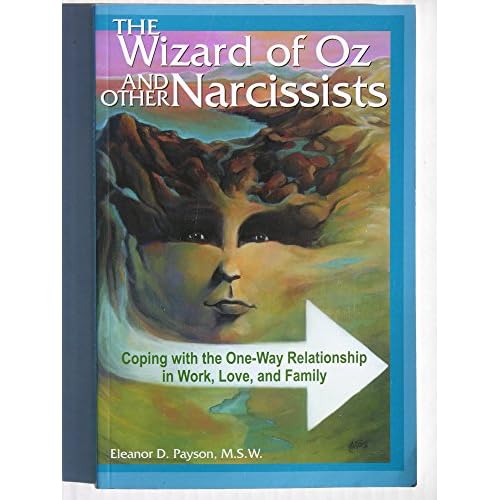
#5: The Wizard of Oz and Other Narcissists — The sleeper pick
Eleanor D. Payson
The one-way relationship decoded — Payson’s Oz metaphor (the great and powerful projection, the small man at the controls) organizes the clearest field guide to everyday narcissism.
- The Oz metaphor — the great projection, the small man at the controls — organizes everything memorably
- Best coverage of the one-way relationship across settings: family, work, church, friendship
- Excellent on the codependent counterpart role and how to exit it
- A small-press sleeper that outperforms famous titles
- Production values and editing show the small-press origins
- Less research scaffolding than the clinician-authored competition
Read it if you want to understand one-sided relationships at work, home or in love.
Skip it if you want recent research.
Pairs with Disarming the Narcissist (#2).
#6: Trapped in the Mirror — Best for adult children
Elan Golomb
Golomb — herself a child of narcissists — on how such parents conscript children into reflections, and how the adult struggle for a real self proceeds. Literary, dark, and true.
- The deepest account of the child-as-mirror dynamic — written by a psychologist raised by narcissists
- Literary, honest, and unsparing where the genre tends to formula
- Maps the adult aftermath — self-doubt, perfectionism, borrowed selves — with rare precision
- Case material that reads like memoir, in the best way
- Dark and diagnostic — offers understanding more than a recovery program
- Dated in places; the clinical frame predates current attachment language
Read it if you grew up with narcissistic parents and are rebuilding your sense of self.
Skip it if you want quick strategies.
Pairs with Will I Ever Be Good Enough? (#3).
2 more titles round out our list, all shown in the quick picks above: People of the Lie by M. Scott Peck (1983) — malignant narcissism examined as evil, case by case; The Narcissism Epidemic by Jean M. Twenge & W. Keith Campbell (2009) — the data on rising cultural narcissism.
How the top picks compare
Best overall Rethinking Narcissism | Best for coping Disarming the Narcissist | Best for daughters Will I Ever Be Good Enough? | Sharpest anatomy Why Is It Always About You? | The sleeper pick The Wizard of Oz and Other Narcissists | |
|---|---|---|---|---|---|
|
|
|
|
|
| |
| Our rating | 9.0 /10 | 8.9 /10 | 8.8 /10 | 8.6 /10 | 8.5 /10 |
| Format | Psychology | Psychology / self-help | Psychology / recovery | Psychology | Psychology |
| First published | 2015 | 2013 | 2008 | 2002 | 2002 |
| Price | $23.80 | $25.44 | $10.92 | $10.02 | $14.95 |
| BUY NOW | BUY NOW | BUY NOW | BUY NOW | BUY NOW |
How we picked these narcissism books
-
What we looked for
We separated books by who they are for: readers who want to understand narcissism as a trait, people living or working with someone narcissistic, and adult children of narcissistic parents. Each pick is written by a psychologist or therapist and describes narcissism as a pattern of behaviour, not a label to put on anyone who hurt you.
-
What shaped the list
We left out books that diagnose public figures or rely mainly on internet terminology.
Which book on narcissism should I read first?
Rethinking Narcissism by Craig Malkin — it gives you the spectrum model everything else fits into, and it’s honest about healthy narcissism and echoism, not just the disorder. Then choose by situation: Behary for coping, McBride for recovering from a narcissistic parent.
Can a narcissist change?
Rigid narcissistic personality disorder changes rarely and slowly, and only with sustained treatment the person actually wants — which the condition itself makes unlikely. Traits short of the disorder are more malleable. The practical books all agree on the corollary: plan around the pattern you observe, not the change you hope for.
Is everyone a narcissist now? The word is everywhere.
No — clinically diagnosable NPD affects a small minority. What’s everywhere is the vocabulary. Some of that spread is useful (patterns got names), much is inflation that flattens every difficult person into a folk devil. The better books, especially Malkin and Twenge, keep the distinction sharp.
How do I know if the problem is my partner's narcissism or something else?
You can’t reliably diagnose from a book, and mostly you don’t need to. What matters is the observable pattern — empathy failures, exploitation, rage at limits — and its effect on you. A therapist of your own is the right instrument for that assessment, especially where safety, children, or divorce are involved.
Bottom line
Malkin to understand the spectrum, Behary to cope with the narcissist you can’t leave, McBride or Golomb to heal from the one who raised you. Skip the monster vocabulary; keep the boundaries.