The Best Books on People-Pleasing: How to Stop Abandoning Yourself
People-pleasing is approval-seeking dressed as kindness — saying yes from fear, managing everyone's feelings but your own, and slowly disappearing from your own life. The pattern has real roots (often in childhoods where love was conditional on being easy) and a real cost: resentment, burnout, and relationships with a stranger who's been performing you. Eight books, ranked.
The best book on people-pleasing is Aziz Gazipura’s Not Nice — the fullest account of niceness as fear wearing a halo, with the boldness training to match. Add Harriet Braiker’s classic The Disease to Please for the cognitive roots, and The Courage to Be Disliked for the philosophical cure.
- Niceness is not kindness Gazipura’s core distinction: kindness gives freely from choice; niceness is fear of disapproval wearing a halo — compulsive, resentful underneath, and dishonest about both.
- The pattern is learned, and often early Braiker and the recovery shelf trace pleasing to environments where approval was survival — the adult habit is an old strategy that no longer checks whether the danger is still real.
- Recovery is tolerating displeasure, not becoming harsh Every serious book converges here: the skill is bearing the discomfort of someone’s disappointment without rushing to fix it — warmth stays, the compulsion goes.
This guide is part of our psychology books to understand yourself silo — people-pleasing is a self-knowledge problem before it is a skills problem: you cannot state a preference you have stopped letting yourself feel.
Why you please — the machinery under the smile
Braiker’s cognitive account still organizes the field: people-pleasing runs on shoulds — I should never disappoint anyone; their needs come first; if someone is upset with me, I’ve failed — installed early and enforced by anxiety. Say no, feel the spike, apologize, feel relief: the loop trains itself. Add the identity layer — being “the easy one,” “the reliable one” — and the pattern stops feeling like behavior and starts feeling like self, which is exactly what makes it hard to see.
The cost ledger is longer than it looks. Chronic pleasers report resentment that leaks sideways, intimacy that stalls (nobody can love a performance), decision paralysis from a preference-detector worn to static, and the particular exhaustion of a nervous system scanning every room for displeasure. Gazipura’s addition is the honesty point: niceness is also a subtle deception — the people around you are relating to a curated compliance, and calling that kindness flatters the fear that built it.
Which book for which pleaser
Start with Not Nice if you want the full program — Gazipura is a recovered pleaser himself, and his boldness training (discomfort on purpose, small honest acts, asking directly) is the most complete on the shelf. Braiker’s The Disease to Please is the classic cognitive treatment — her 21-day plan aged well, and the should-audit is still the sharpest diagnostic instrument. Tawwab’s Set Boundaries, Find Peace supplies the actual sentences — the operational manual for the moment of no.
The rest sharpen specific edges. The Courage to Be Disliked reframes the whole enterprise through Adler: separation of tasks — whose problem is their reaction? — is the single most liberating idea a pleaser can import. Smith’s When I Say No, I Feel Guilty is the old-school assertiveness manual, dated in tone and still unmatched on verbal technique (broken record, fogging, negative assertion). Turrell’s Please Yourself is the best recent British entry — therapist-smart on the four pleaser types. And for pleasing that shades into caretaking-as-identity, Beattie’s Codependent No More remains the deeper book underneath this one.
Independently researched and ranked by our editorial team. As an Amazon Associate, this site earns from qualifying purchases made through the links below.
How to choose a people-pleasing book
- Program, philosophy, or scripts
The shelf offers training plans, reframes, and sentence-level tools — pleasers usually need one of each.
Look forGazipura or Braiker for the program, Kishimi and Koga for the reframe, Tawwab or Smith for the words in the moment.AvoidCollecting reframes while dodging the practice — the pattern only changes in the discomfort you've been avoiding. - How deep the roots go
Habit-level pleasing and identity-level caretaking are different sizes of problem.
Look forBraiker or Turrell for the habit; Beattie, Rapson and English — or a therapist — when the pleasing is who you've been since childhood.AvoidExpecting a scripts book to fix an attachment pattern; the sentence isn't the hard part. - Your fear of becoming unkind
The most common reason pleasers quit the work is dread of turning selfish.
Look forBooks that keep the kindness-niceness distinction sharp — Gazipura is built on it; honesty plus warmth is the target.AvoidOvercorrection content that treats bluntness as liberation — the goal is a real self in relationships, not a spikier performance.




#1: Not Nice — Best overall
Aziz Gazipura
A recovered pleaser turned psychologist dismantles the niceness contract and rebuilds from honesty — with graded boldness exercises that treat discomfort as the training surface itself.
- The niceness-as-fear diagnosis is the sharpest on the shelf, from a recovered pleaser
- Graded boldness training treats discomfort as the practice surface — which is exactly right
- Covers the full range: saying no, asking directly, disagreeing, being seen
- Long enough to be a program, not a pep talk
- Verbose — the same point often made three ways
- The bro-adjacent tone in places puts some readers off the substance
Read it if you want direct exercises to stop pleasing and start saying what you think.
Skip it if you prefer a gentle tone.
Pairs with The Disease to Please (#2).
#2: The Disease to Please — The classic
Harriet B. Braiker
Braiker’s triangle of pleasing mindsets, habits, and feelings, plus the 21-day program — the book that first mapped people-pleasing as a compulsion rather than a personality.
- The triangle — pleasing mindsets, habits, feelings — still organizes the problem best
- The should-audit is the sharpest diagnostic tool in the genre
- 21-day program gives structure without overwhelm
- A clinical psychologist’s precision under accessible prose
- Examples and idiom have aged since 2001
- Less on the attachment roots than newer books
Read it if you want the classic structured program for people-pleasing.
Skip it if you want a recent book.
Pairs with Not Nice (#1).
#3: Set Boundaries, Find Peace — Best on boundaries
Nedra Glover Tawwab
The scripts for the moment of no — work, family, friends, phones — from a therapist direct about guilt: it’s a feeling you can survive, not a stop sign.
- The actual sentences — scripts for work, family, friends, and phones
- Boundary types and violations taxonomized so you can locate your specific problem
- Modern, secular, therapy-literate — no recovery-movement prerequisites
- Direct about guilt: it’s a feeling, not a stop sign
- Lighter on the deep origins — Mellody covers what Tawwab moves past
- Instagram-era brevity means some hard cases get quick treatment
Read it if you know what you want to say but not how.
Skip it if you want to understand why you please.
Pairs with Not Nice (#1).
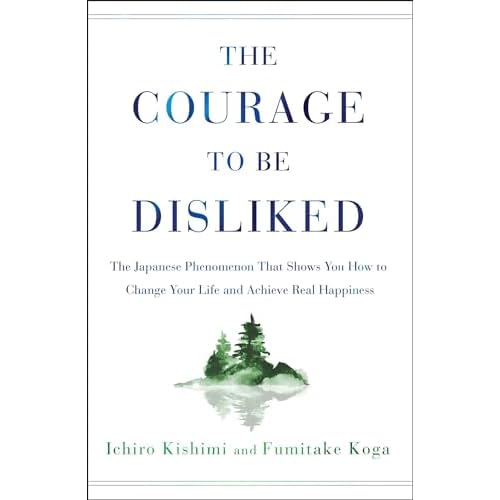
#4: The Courage to Be Disliked — Best philosophical
Ichiro Kishimi & Fumitake Koga
A Socratic dialogue on Adlerian psychology: other people’s reactions are their task, not yours, and freedom costs the willingness to be disliked. Strange format, permanent furniture.
- Separation of tasks — their reaction is their task — is the single most liberating idea a pleaser can import
- Dialogue format makes hard philosophy genuinely readable
- Adler’s framework (all problems are interpersonal problems) reframes the entire issue
- A worldwide phenomenon for a reason — it sticks
- The philosopher’s sweeping claims (trauma ‘does not exist’) need charitable translation
- Socratic back-and-forth frustrates readers who want the points stated straight
Read it if you respond to ideas and want a new way to see approval.
Skip it if you want step-by-step exercises.
Pairs with Not Nice (#1).
#5: When I Say No, I Feel Guilty — The assertiveness classic
Manuel J. Smith
The 1975 assertiveness manual whose techniques still work verbatim: how to hold a no under pressure, absorb criticism without collapse, and negotiate without apology.
- Verbal techniques — broken record, fogging, negative assertion — that still work verbatim fifty years on
- Teaches holding a no under sustained pressure, which no newer book does as concretely
- Systematic desensitization logic underneath the scripts
- The dialogues show technique in motion, objection by objection
- Dated examples and a combative 1970s frame
- Treats assertion mechanics more than the feelings underneath — pair with Braiker or Gazipura
Read it if you want classic assertiveness techniques for pressure situations.
Skip it if you want a modern voice.
Pairs with Set Boundaries, Find Peace (#3).
#6: Please Yourself — Best recent
Emma Reed Turrell
A therapist’s field guide — classic, shadow, pacifier, resistor — with case-rich chapters on pleasing at work, in families, and online. The sharpest recent entry on the shelf.
- The four pleaser types give readers a precise mirror fast
- Case-rich chapters on work, family, friendship, and online pleasing
- A practicing therapist’s ear for the exact sentences pleasers say to themselves
- The best recent entry — current idiom, current pressures
- Lighter on structured practice than Gazipura or Braiker
- UK context occasionally needs translating
Read it if you want a recent therapist's guide with many case examples.
Skip it if you want a short book.
Pairs with The Disease to Please (#2).
2 more titles round out our list, all shown in the quick picks above: Codependent No More by Melody Beattie (1986) — when pleasing is caretaking-as-identity; Anxious to Please by James Rapson & Craig English (2006) — chronic niceness traced to anxious attachment.
How the top picks compare
Best overall Not Nice | The classic The Disease to Please | Best on boundaries Set Boundaries, Find Peace | Best philosophical The Courage to Be Disliked | The assertiveness classic When I Say No, I Feel Guilty | |
|---|---|---|---|---|---|
|
|
|
|
|
| |
| Our rating | 9.0 /10 | 8.8 /10 | 8.9 /10 | 8.7 /10 | 8.4 /10 |
| Format | Psychology / self-help | Psychology / self-help | Self-help / boundaries | Philosophy / psychology | Assertiveness / self-help |
| First published | 2017 | 2001 | 2021 | 2018 | 1975 |
| Price | $14.90 | $10.79 | $14.24 | $12.16 | $6.75 |
| BUY NOW | BUY NOW | BUY NOW | BUY NOW | BUY NOW |
How we picked these people-pleasing books
-
What we looked for
We chose books that each address one part of people-pleasing: fear of disapproval, the guilt of saying no, practical assertiveness, and the belief that other people’s reactions are your responsibility. We included one older classic because its assertiveness techniques are still widely taught, and one philosophical book for readers who respond to ideas more than exercises.
Which people-pleasing book should I read first?
Not Nice for the full program, or Braiker’s The Disease to Please if you want the classic cognitive version. If your sticking point is the actual conversation — saying no to a real person this week — start with Tawwab and borrow Smith’s techniques.
Is people-pleasing the same as codependency?
They overlap but aren’t identical. People-pleasing is approval-driven compliance; codependency organizes a whole identity around managing another person’s life or addiction. If your pleasing centers on one troubled relationship rather than everyone, start with the codependency shelf — Beattie first.
How do I stop people-pleasing without becoming rude?
The distinction that protects you: kindness is freely chosen, niceness is fear-driven. Recovery means keeping warmth while dropping compulsion — saying no plainly, letting others feel disappointed without rushing to fix it. Rudeness is an overcorrection the good books explicitly warn against.
Why do I feel so guilty when I say no?
Because the pattern trained your nervous system to read displeasure as danger — often from childhoods where approval was safety. The guilt is a conditioned alarm, not a moral verdict. It fires loudest early in recovery and fades with repetition; every book here treats surviving that feeling as the core skill.
Bottom line
Gazipura for the program, Braiker for the roots, Tawwab for the sentences, Adler via Kishimi for the philosophy. Kindness stays, the fear goes — and the guilt you feel saying no is an alarm, not a verdict.