Which Nietzsche Translation: Kaufmann or Hollingdale?
With Nietzsche the translation question is unusually serious, because the worst English versions were shaped by a sister who rewrote his politics after he collapsed.
Walter Kaufmann rehabilitated Nietzsche in English from the 1950s and his versions carry substantial notes. R. J. Hollingdale translated most of the same books for Penguin with a lighter touch. Both are excellent. The editions to avoid are the free ones, which descend from a period when Nietzsche’s reputation had been deliberately corrupted.
- Kaufmann when you want the notes and the argument explained
- Hollingdale when you want Nietzsche's prose to move
- Avoid free public-domain editions entirely — this is the one author where it matters
Kaufmann for a first serious reading — his notes explain the references and flag the irony. Hollingdale’s Penguin editions read faster for someone who knows the terrain. Avoid free public-domain Nietzsche: those versions date from when his sister controlled his estate and had shaped his reputation toward her own politics.


Start here: On the Genealogy of Morals / Ecce Homo
Walter Kaufmann · Vintage · 384 pages
The book where Nietzsche argues most carefully rather than most memorably, in the translation that rescued him from fifty years of misuse. Kaufmann’s notes tell you which passages were distorted and how, which is not scaffolding you get anywhere else.
- Sustained argument rather than scattered aphorisms
- Kaufmann’s notes address the distortion history directly
- Pairs the argument with the autobiography
- The standard scholarly English edition
- The apparatus is heavy for a casual reader
- Ecce Homo’s grandiosity puts some readers off
- Not the easiest first Nietzsche
Worked example: one aphorism, two translators
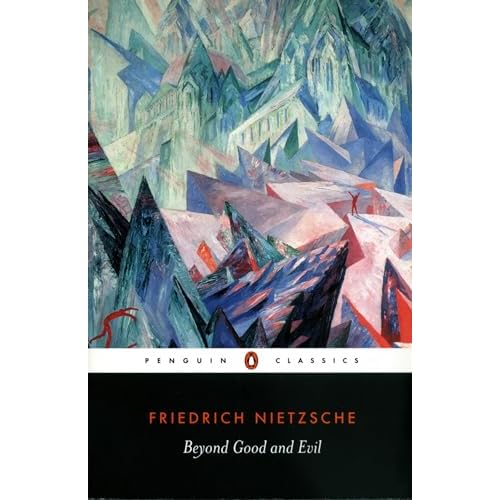
Section 146 of Beyond Good and Evil is the one most people have seen on a poster: the warning about fighting monsters and the abyss that looks back. It is two sentences long, which makes it a fair test. Kaufmann renders it with a slightly formal cadence and adds a footnote connecting it to Nietzsche’s earlier remarks on ressentiment, so the reader learns that it is not a stray piece of advice but a thread in an argument about how moral crusaders become what they oppose. Hollingdale gives it in plainer, faster English with no note. Read in isolation the Penguin version lands harder; read as part of the book, Kaufmann’s version tells you what it is doing there.
That is the whole difference in miniature. Nietzsche’s aphorisms are self-contained enough that a translator with a good ear can make each one sing, and Hollingdale has the better ear. But they are also cross-referenced across a dozen books, and a first-time reader does not have the map. Kaufmann’s notes are the map. The honest recommendation is therefore not one or the other but a sequence: Kaufmann for the first serious pass, Hollingdale when you return.
The free editions fail this test in a different way. The early translations of Zarathustra and the compilation published as The Will to Power were produced while Elisabeth Förster-Nietzsche controlled the papers, and The Will to Power in particular is an arrangement she made from notebooks he had abandoned. A modern edition will tell you this in the introduction. A free one will not, and will sometimes present the compilation as his final statement. This is why the Nietzsche starting guide treats edition choice as part of the reading order rather than a footnote to it.
Nietzsche is the loudest voice in the existentialism reading hub but not the only one with a translation problem. Kierkegaard suffers from the opposite issue, with excellent recent translations that are expensive and old ones that are free and stiff, and Schopenhauer, whom Nietzsche read obsessively, is readable in almost anything. If you want the philosophical argument without the aphoristic style, Heidegger and Sartre pick up where section 146 leaves off.
Nietzsche collapsed in 1889 and his sister Elisabeth took control of his papers, assembling unpublished fragments into a book he never wrote and steering his reputation toward her own politics. The earliest English translations date from that period. Modern editions work from the restored critical text — which is why, uniquely here, the price difference is worth paying.
Side by side
Best Kaufmann On the Genealogy of Morals / Ecce Homo | Best entry Beyond Good and Evil | Read last Thus Spoke Zarathustra | |
|---|---|---|---|
|
|
|
| |
| Edition | Kaufmann, Vintage | Penguin Classics | Penguin Classics |
| Length | 384 pages | 240 pages | 352 pages |
| Difficulty | 7 /10 | 6 /10 | 9 /10 |
| Good first Nietzsche | No | Yes | No |
| Price | $18.00 | $12.12 | $11.48 |
| BUY NOW | BUY NOW | BUY NOW |
Picking the right entry point
The free versions descend from a compromised period in Nietzsche’s publication history.
Kaufmann explains; Hollingdale flows. Both are faithful, and the choice is about what you need.
It is the famous one and the least useful entry point, written as a prose poem that parodies scripture.
A numbered section of half a page is a complete argument. Reading fifty in a sitting defeats the form.
Kaufmann or Hollingdale for Nietzsche?
Kaufmann for a first serious reading — his notes explain the references and flag the irony, which matters with a writer this often misread. Hollingdale’s Penguin versions read faster and suit someone who already knows the terrain. Both are faithful.
Why should I not read free Nietzsche translations?
Because the earliest English versions date from the period when his sister Elisabeth controlled his estate and had shaped his posthumous reputation toward her own politics. Modern translations work from the restored critical text.
Which Nietzsche book should I read first?
Beyond Good and Evil. The aphorisms are short enough to take one at a time and it represents his mature thinking. Thus Spoke Zarathustra is the famous one and the worst place to begin.
Does the translation change Nietzsche much?
More than with most philosophers. He writes in aphorisms where rhythm carries the force of the argument, so a translator’s ear affects how the ideas land, not merely how they read.
The short version
- Kaufmann for notes, Hollingdale for momentum
- Never the free public-domain editions
- Beyond Good and Evil first, Zarathustra last
Buy a modern translation — this is the one author where the free editions carry a real historical problem. Kaufmann if you want the notes, Hollingdale if you want the prose to move. Start with Beyond Good and Evil and leave Zarathustra until last.