Books for an Existential Crisis: 7 That Actually Help
An existential crisis doesn't respond to ordinary self-help — being told to optimize your morning routine while questioning existence itself is almost funny. These seven books take the questions seriously, matched to which one has you.
The best book for an existential crisis is Viktor Frankl’s Man’s Search for Meaning — short, unanswerable proof that meaning survives anything. Pair it with Irvin Yalom’s Staring at the Sun if the crisis centers on death, Rollo May’s Man’s Search for Himself for emptiness, or Camus’s The Myth of Sisyphus for the absurd.
- Crisis is not malfunction The existential tradition reads the crisis as accurate perception arriving all at once — a signal to build, not a symptom to suppress.
- Name your given Death, freedom, isolation, meaninglessness — the right book depends on which of the four has your attention.
- Short and direct wins Mid-crisis, slim books you can finish — Frankl, Camus, May — beat 500-page systems you can’t.
This guide is part of our best books on the meaning of life silo — the full silo covers meaning, mortality and the philosophers behind both.
What an existential crisis actually is
Strip the drama from the phrase and something precise remains: the moment the usual distractions fail and the basic facts of the human situation — death, freedom, aloneness, the absence of given meaning — arrive with full force. Yalom calls these the four givens, and his clinical claim is steadying: confronting them directly is painful but tends to make life more vivid, not less.
That is why books help at all. The crisis feels like a private malfunction; the existential shelf demonstrates it is a shared, ancient, survivable encounter — and that people have returned from it with something usable.
Matching the book to the question
If the question is what’s the point? — Frankl, who watched meaning survive the worst place on earth, or Camus, who answers the absurd with defiance rather than comfort. If it is I’m going to die — Yalom’s Staring at the Sun, the one book on this list aimed squarely at death anxiety.
If it is I feel empty and don’t know who I am — Rollo May’s Man’s Search for Himself, written for exactly that hollowness. And if the crisis coincides with a round-numbered birthday, Kieran Setiya’s Midlife applies real philosophy to the “is this all?” feeling with surprising practicality.
Independently researched and ranked by our editorial team. As an Amazon Associate, this site earns from qualifying purchases made through the links below.




#1: Man's Search for Meaning — Best overall
Viktor E. Frankl
Four hours of reading, a lifetime of ballast: Frankl’s testimony that meaning can be chosen in any conditions whatsoever. The first book to hand anyone in the pit.
- First-person Holocaust testimony fused with a psychiatry of meaning — there is nothing else like it
- Short (about 165 pages); part one can be read in a single sitting and rarely lets go
- The core claim — a ‘why’ makes almost any ‘how’ bearable — has held up in palliative and trauma care
- The Beacon edition includes Frankl’s 1984 postscript on tragic optimism
- Verified buyers regularly complain the Beacon mass-market printing has small, tight type — pick the larger trade paperback if your eyes are older
- Part two, the logotherapy lecture, is far drier than the memoir; many readers stall there
- Light on method — it tells you meaning matters, not how a session works
#2: Staring at the Sun — Best for death anxiety
Irvin D. Yalom
Yalom’s direct manual for death terror — the rippling concept, the awakening experiences, forty years of dying patients who became more alive. Warm where the topic is cold.
- The most direct treatment of death anxiety written for general readers, not clinicians
- The ‘rippling’ idea — living on through your effect on others — is the concept readers most often single out as consoling without religion
- Short and plainly written; blends memoir, case material, and philosophy
- Yalom writes it in his mid-seventies, facing the subject himself — the honesty shows
- Readers of Existential Psychotherapy will recognize recycled material and case stories
- Some case dialogues feel condensed and a little too neatly resolved
- The hardback layout pads a modest text; it is a shorter book than it looks
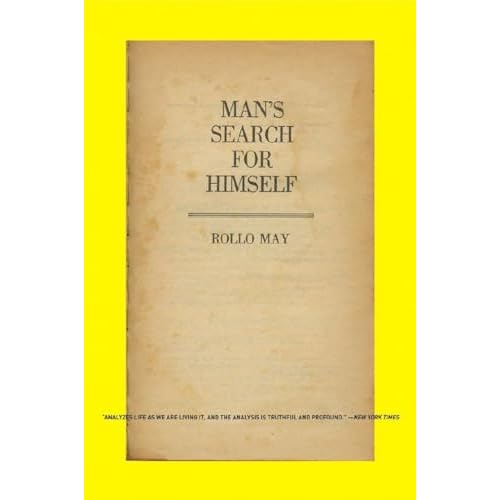
#3: Man's Search for Himself — Best for emptiness
Rollo May
May’s 1953 diagnosis of emptiness, loneliness and anxiety — and his prescription of self-authorship — reads as if written about this decade.
- May’s most readable book — anxiety, loneliness, and emptiness in plain mid-century prose
- The ‘hollow people’ diagnosis of modern emptiness anticipated the culture-of-narcissism critiques by decades
- Practical chapters on selfhood and courage that general readers can actually use
- 1953 references and gender assumptions date whole passages
- The middle chapters circle the same argument more than once
#4: The Myth of Sisyphus — The philosophical classic
Albert Camus
Camus begins where the crisis does — is life worth living? — and argues through to revolt, freedom and passion. One must imagine Sisyphus happy; one must read this to see why.
- The absurd stated directly: the essay that begins with ‘the only serious philosophical problem’
- The title essay is short, and the closing image — one must imagine Sisyphus happy — is the tradition’s most quoted line
- The interpretive key to The Stranger and The Plague
- The first third — a survey of Kierkegaard, Husserl, and Jaspers — is the hardest stretch, and reader reviews are full of near-abandonments there
- The appended essays in the back half are noticeably weaker than the title piece
#5: Midlife: A Philosophical Guide — Best for midlife
Kieran Setiya
An MIT philosopher takes the midlife crisis seriously — with actual arguments, including the telic/atelic distinction that reframes what living is for.
- A real philosopher (MIT) takes the midlife crisis seriously — and offers arguments, not affirmations
- The telic/atelic activities distinction gives readers a usable tool against the ‘is this all?’ feeling
- Engages Schopenhauer, Mill and Simone de Beauvoir without needing prior philosophy
- The prose is professor-casual — jokes that don’t always land, digressions into thought experiments
- Aimed at the comfortable midlife reader; crisis driven by real loss needs a different book
#6: When Nietzsche Wept — Best as story
Irvin D. Yalom
The existential ideas smuggled inside a page-turner — despair, freedom and amor fati dramatized in 1882 Vienna. For when you can’t face nonfiction.
- Teaches Nietzsche’s core ideas and the birth of talk therapy inside a novel you actually want to finish
- The Breuer–Nietzsche dialogues dramatize amor fati and eternal recurrence better than most textbooks
- An afterword separates historical fact from invention, so you know what you learned
- Consistently the highest-rated Yalom title among general readers
- The characters talk like modern therapists — the dialogue is openly anachronistic
- The central premise is invented: Breuer and Nietzsche never met
- Readers who want the real philosophy will still need the primary texts
How to choose a book mid-crisis
- Which given has you
Death, meaninglessness, emptiness and absurdity call for different books.
Look forYalom for death, Frankl for meaning, May for emptiness, Camus for absurdity.AvoidGrabbing the most famous title when a better-matched one is on the list. - Finishable length
Mid-crisis attention is short; completion matters psychologically.
Look forSlim volumes first — Frankl, Camus, Yes to Life are all one-to-three sittings.AvoidOpening a 500-page system (Being and Nothingness) as a first responder. - Crisis vs emergency
An existential crisis is workable; despair with hopelessness may need more than books.
Look forBooks as companions — and a professional if the weight isn't lifting.AvoidWhite-knuckling a true depression with philosophy alone.
What is the best book to read during an existential crisis?
Viktor Frankl’s Man’s Search for Meaning — it is short enough to finish mid-crisis and offers living proof that meaning can be found under any conditions. Match further by theme: Staring at the Sun for death anxiety, Man’s Search for Himself for emptiness, The Myth of Sisyphus for absurdity.
Is an existential crisis a mental illness?
No — it is a normal, often productive confrontation with real facts of existence, and thinkers from Kierkegaard to Yalom treat it as a doorway to a more honest life. But if it comes with persistent hopelessness, an inability to function, or thoughts of self-harm, that is depression territory and deserves professional support alongside any reading.
Can books actually help with an existential crisis?
Yes, in a specific way: they convert a private-feeling malfunction into a shared, ancient, survivable human encounter, and they offer tested responses — Frankl’s meaning, Camus’s revolt, Yalom’s connection. What they can’t do is decide your answer for you; the existentialists insist that part is yours.
Should I read philosophy or psychology first?
Psychology first if you want company and method — Frankl, Yalom and May write for the person in the crisis. Philosophy first if you want the argument at full strength — Camus and Setiya. Many readers alternate: one book that holds your hand, then one that shakes it.
Bottom line
Name which given has you, then pick: Frankl for meaning, Yalom for death, May for emptiness, Camus for the absurd, Setiya for midlife, and the novel when nonfiction won’t go down. Keep the books short, finish them, and get real support if the weight doesn’t lift.