Alain de Botton Books Guide: Where to Start with Philosophy for Daily Life
Alain de Botton built a career on one bet: that philosophy exists to console and instruct, not to impress other philosophers. Critics call it middlebrow; millions of readers call it the book that helped. Here are his eight essential books ranked, and the honest order to read them in.
Start Alain de Botton with The Consolations of Philosophy — six philosophers applied to six ordinary miseries, and the clearest sample of what he does. Then The Course of Love, his best book, and Status Anxiety. The School of Life collects the mature project in a single volume.
- Philosophy as consolation is an old idea he revived Boethius wrote The Consolation of Philosophy in a death cell; de Botton’s project is that tradition — wisdom applied to ordinary suffering — in modern packaging.
- The Course of Love is the keeper His return to fiction — a whole marriage, annotated — carries the mature psychology: love as a skill to be learned rather than an emotion to be found.
- He is a door, not a destination The books quote Seneca, Proust, and Kierkegaard generously — the right use is following the quotes back to the sources this silo maps.
This guide is part of our books on the meaning of life silo — de Botton is the gateway author for readers who want philosophy applied to love, work, and status anxiety before they tackle the primary texts.
What de Botton actually does — and why the critics miss the point
The project has been consistent since the 1990s: take philosophy’s claim to teach the art of living seriously, and write books that actually attempt it. The Consolations of Philosophy assigns six thinkers to six ordinary miseries — Seneca for frustration, Schopenhauer for heartbreak, Nietzsche for difficulty — and Status Anxiety diagnoses the meritocratic disease: when success is deserved, failure is too, and everyone’s position becomes a verdict. The style is aphoristic, essayistic, and deliberately hospitable to readers philosophy usually locks out.
The standard criticism — that this is philosophy-lite — half lands. De Botton simplifies, and academics wince. But the tradition he works in is older than the academy’s objection: Epicurus ran a garden, not a peer review; Seneca wrote letters to a friend; Boethius consoled himself awaiting execution. Judged as scholarship the books are thin; judged as what they are — invitations that send readers to Seneca, Proust, and Kierkegaard — they may move more people toward real philosophy than the academy does.
The reading order, from consolations to the school
Start with The Consolations of Philosophy: it is the mission statement and the best sampler. Then jump to the mature work: The Course of Love, his finest book — a novel of one whole marriage, interleaved with essayistic commentary, arguing that love is a skill rather than an enthusiasm, and that compatibility is an achievement of love, not its precondition. Yalom readers will recognize the therapeutic sensibility; the book is practically couples therapy in narrative form. Status Anxiety completes the essential trio.
After that, choose by need. How Proust Can Change Your Life is the charming breakthrough book and still the funniest. Essays in Love, the début, runs a single love affair through philosophical analysis — younger, showier, and the fan favorite. The Art of Travel applies the method to why trips disappoint; Religion for Atheists proposes stealing ritual and community from the faiths without the metaphysics — his most argued-with book. The School of Life collects the mature project — emotional education, self-knowledge, calm — into the single volume to keep by the bed.
Independently researched and ranked by our editorial team. As an Amazon Associate, this site earns from qualifying purchases made through the links below.




#1: The Consolations of Philosophy — Start here
Alain de Botton
Socrates for unpopularity, Seneca for frustration, Schopenhauer for heartbreak, Nietzsche for hardship — philosophy re-employed as consolation. The definitive first de Botton.
- The mission statement — six philosophers matched to six ordinary miseries
- Ideal sampler: Seneca, Montaigne, Schopenhauer, Nietzsche in one book
- Genuinely consoling — the Boethius tradition revived in earnest
- Sends readers to the primary texts better than any syllabus
- Simplifies each thinker — academics wince, sometimes fairly
- The matching of philosopher to problem occasionally feels engineered
#2: The Course of Love — His best book
Alain de Botton
Rabih and Kirsten from meeting through marriage, children, an affair, and repair — fiction interleaved with commentary on why love is a skill. His deepest and most useful book.
- His best book — a whole marriage narrated and annotated
- Love as a skill to learn, not an emotion to find — the mature thesis
- The commentary earns its interruptions; practically couples therapy in narrative form
- Honest about compromise, sulks, an affair, and repair
- The essayistic interruptions annoy readers wanting a plain novel
- Rabih and Kirsten sometimes read as specimens rather than people
#3: Status Anxiety — Best diagnosis
Alain de Botton
When position is deserved, failure becomes a moral verdict — the anxiety that follows, and five old remedies: philosophy, art, politics, religion, bohemia. More relevant every year.
- Named the meritocratic disease before the discourse caught up
- The diagnosis — deserved success makes failure a moral verdict — cuts deep
- Five remedies traced through history: philosophy, art, politics, religion, bohemia
- Remedies section is thinner than the diagnosis
- Covers ground his later books rework more tightly
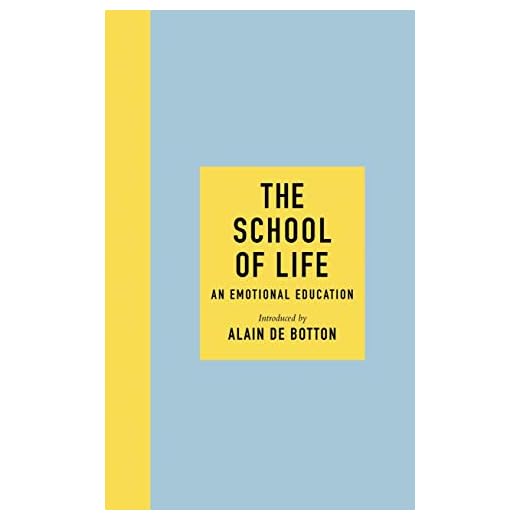
#4: The School of Life: An Emotional Education — The summa
Alain de Botton
Self-knowledge, emotional skepticism, love as pedagogy, calm — the distilled curriculum of the school he founded. The single-volume de Botton if you’re only buying one.
- The mature project distilled into one bedside volume
- Emotional skepticism and self-knowledge chapters are his strongest essay work
- The best single purchase for readers who want one de Botton
- Compilation texture — themes repeat from earlier books
- The institutional School of Life voice occasionally flattens his own
#5: How Proust Can Change Your Life — The breakthrough
Alain de Botton
Proust as advice columnist: how to suffer successfully, take your time, and open your eyes. The 1997 book that invented the de Botton genre and still its most charming entry.
- The funniest de Botton — the genre-inventing 1997 breakthrough
- Proust made approachable without being diminished
- The chapter titles alone (‘How to Suffer Successfully’) earn the price
- Slighter than the mature work — charm over depth
- Readers may finish it without any actual urge to read Proust, which defeats the point
#6: On Love — The début
Alain de Botton
Written at 23: a single relationship from airplane meet to heartbreak, analyzed clause by clause. Showier and younger than The Course of Love — read them as before-and-after.
- A whole love affair analyzed clause by clause — the fan favorite début
- Written at 23 and startlingly assured
- Reads as the perfect before-picture to The Course of Love’s after
- Showier and more precious than the mature work
- The analysis sometimes suffocates the feeling it dissects
2 more titles round out our list, all shown in the quick picks above: The Art of Travel by Alain de Botton (2002) — why trips disappoint — anticipation, arrival, and attention; Religion for Atheists by Alain de Botton (2012) — stealing ritual and community without the metaphysics.
How the top picks compare
|
Start here
The Consolations of Philosophy
|
His best book
The Course of Love
|
Best diagnosis
Status Anxiety
|
The summa
The School of Life: An Emotional Education
|
The breakthrough
How Proust Can Change Your Life
|
|
|---|---|---|---|---|---|
|
|
|
|
|
|
|
| Our rating | 8.9 /10 | 9.0 /10 | 8.7 /10 | 8.6 /10 | 8.5 /10 |
| Format | Philosophy / essays | Novel / essays | Philosophy / social criticism | Philosophy / self-help | Literary self-help |
| First published | 2000 | 2016 | 2004 | 2019 | 1997 |
| Price | $17.71 | $10.89 | $19.00 | $16.95 | $9.95 |
| BUY NOW | BUY NOW | BUY NOW | BUY NOW | BUY NOW |
How to choose your de Botton
-
Your entry problemThe books are organized by misery — pick yours.Look forConsolations for general suffering, Course of Love or On Love for relationships, Status Anxiety for career comparison spirals.AvoidReading chronologically out of completism — the early books are apprenticeship for the mature ones.
-
Fiction or essaysThe love books are novels with commentary; the rest are pure essay.Look forThe Course of Love if you want ideas carried by characters; The School of Life for the same material as curriculum.AvoidExpecting conventional novels — the interruptions to annotate are the genre, not a flaw in it.
-
Door or destinationHis best use is as a bridge to the primary texts.Look forThe quotes and heroes — Seneca, Schopenhauer, Proust, Kierkegaard — and follow them into the sources.AvoidStopping at the paraphrase when the book itself keeps pointing past the paraphrase.
How we chose these books
-
Firsthand reading
Rankings start from our editors’ full reads of every title on the list — including the slow middles and the failed first attempts — not from publisher copy.
-
Reader-review analysis
We mined verified-purchase reviews, Goodreads consensus, and Reddit reading threads for recurring, specific complaints: print size, abridgments, translation quality, abandonment points.
-
Edition comparison
Where multiple translations or editions exist, we compared them and linked the printing most readers should actually buy — and flagged the known trade-offs.
Which Alain de Botton book should I read first?
The Consolations of Philosophy — it states the whole project and samples six thinkers in one book. If your pressing question is love rather than life in general, start with The Course of Love instead; it’s his best book and needs no prerequisites.
Is Alain de Botton a real philosopher?
Not academically — he left a Harvard PhD to write for general readers and is often dismissed as popularization. But he works in a legitimate ancient tradition: philosophy as the art of living, from Epicurus through Seneca to Boethius. Read him as a gifted essayist and door-opener; keep the primary texts as the destination.
What is The School of Life?
An organization de Botton founded in 2008 — classes, books, and a large YouTube presence teaching emotional intelligence. The book of the same name is the curriculum’s single-volume summary and the best distillation of his mature thought — start there before the spin-off titles.
How does de Botton connect to Yalom and existential therapy?
Both practice the same conviction: ideas exist to help people live and die better. The Course of Love reads like couples therapy in narrative form, Status Anxiety like an existential case study of the comparison disease. De Botton readers graduate naturally to Yalom, Frankl, and the Stoics — the shelves this site maps.
Bottom line
Consolations first, The Course of Love as the keeper, Status Anxiety for the diagnosis, The School of Life by the bed. Treat him as the door, follow his quotes to Seneca and Proust — and don’t apologize for entering through it.