Attachment Styles Explained: The Four, Clearly
Attachment styles are not personality types, and they are not fixed. The research treats them as patterns that shift with circumstance — which is both more hopeful and less tidy than the version circulating online.
The categories came from watching one-year-olds with their mothers in a laboratory. Extending them to adult romantic relationships is a real but genuinely contested step, and the popular three-or-four-label version compresses several decades of nuanced work into something you can take a quiz about.
- Secure — comfortable with closeness and with separation
- Anxious — seeks closeness, fears it will be withdrawn
- Avoidant — values independence, finds closeness effortful
- Disorganised — wants closeness and fears it at once
Four patterns — secure, anxious, avoidant and disorganised — identified in infants by Mary Ainsworth and extended to adult relationships by inference rather than direct measurement. They are patterns that vary by relationship and change over time, not fixed personality types, and movement toward security is well documented.
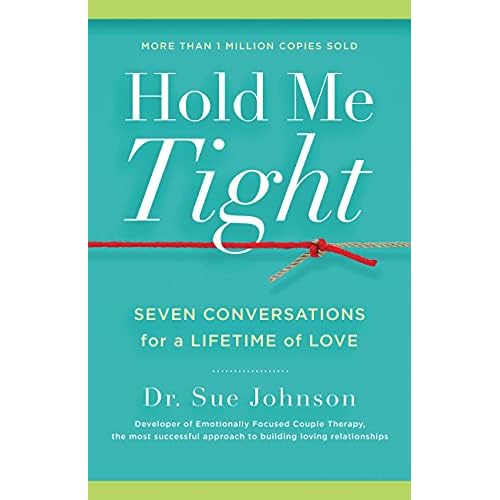


Start here: Hold Me Tight
Sue Johnson · 2008 · 320 pages
Knowing your pattern changes nothing on its own. This turns the theory into seven structured conversations with the person you are actually with, drawn from a couples therapy with real trial support behind it — and it addresses the specific moments where two patterns collide.
- Concrete conversations rather than concepts
- Built on a therapy with genuine evidence
- Works whether or not your partner reads it
- Addresses the moments things actually go wrong
- Aimed at couples, less use if single
- The scripted conversations feel stilted at first
- Assumes both people want to repair
Two patterns colliding
He has gone quiet after an argument. Nothing dramatic — he has stopped replying to messages and has said he needs some space. To him this is self-evidently reasonable: he is upset, he wants to think, he will be fine tomorrow.
To her it is unbearable, and the reason is not that she is unreasonable. Withdrawal reads, to an anxious pattern, as the beginning of an ending. So she does the thing that feels urgent: she messages again, and then calls, and then says something sharper than she means, because the silence is worse than a fight.
Which confirms his reading exactly. From an avoidant pattern, pursuit feels like pressure, and pressure is what makes space necessary. He withdraws further. She pursues harder. Neither is doing anything either would call unreasonable, and both are making the other’s fear come true.
What the attachment frame adds is not blame but a name for the loop. The useful move is almost never resolving the original argument — it is agreeing, in advance and when calm, on what withdrawal will mean and how long it lasts. “I need two hours and I will come back” costs him almost nothing and removes the thing that makes her escalate.
That is the whole of what Sue Johnson’s conversations are for: not diagnosing each other, but interrupting the loop before it runs.
One more thing the frame does well is explain why the loop is so hard to see from inside. Each person is responding reasonably to the other’s last move, so each has a complete account in which they are the sane one. The attachment reading does not adjudicate. It says that both responses are old, learned in relationships neither of them chose, and that the fight is not about the dishwasher. Couples who can hold that thought for even a minute mid-argument usually report that the argument gets shorter, which is a modest claim and the one the evidence supports.
Attachment is the most empirically grounded entry in the concepts series, and also the most over-applied. The attachment theory reading list covers the research books; what to read after Attached is for readers who started with the popular version; and projection describes what happens when the framework is pointed at a partner instead of at oneself. The couples therapy shelf is where Emotionally Focused Therapy sits among its alternatives.
The same loop appears with the roles reversed, and with two anxious or two avoidant partners it takes other shapes entirely. What stays constant is that the pattern is older than the relationship, which is why changing partners so rarely changes it.
Deciding a partner’s attachment style and then reading everything they do through it. The framework is a tool for understanding yourself; aimed outward it becomes a way of winning arguments — “that’s just your avoidant attachment” ends a conversation rather than opening one. Keep it pointed at your own side.
Side by side
Picking the right entry point
“I have an anxious pattern in this relationship” is a usable observation. “I am an anxious” is not, and the research does not support it.
Four labels compress decades of careful work, and the compression is where most of the misuse comes from.
Most popular accounts describe the patterns and stop, leaving readers with a label and no route out.
It is the pattern most associated with frightening early experience and the one least served by self-help.
The framework degrades fast when used on another person.
What are the four attachment styles?
Secure, anxious (sometimes called preoccupied), avoidant (dismissive), and disorganised (fearful-avoidant). The first three came from Mary Ainsworth’s infant research in the 1970s; disorganised was identified later by Mary Main.
Can your attachment style change?
Yes. The research treats these as patterns rather than fixed traits, and they shift with circumstance, relationship and deliberate work. Movement toward security is well documented and is called earned secure attachment.
Are attachment styles scientifically valid?
The infant research is substantial and well replicated. Extending the categories to adult romantic relationships is a real but debated inferential step, and the popular four-label version compresses a far more nuanced literature.
What is disorganised attachment?
A pattern combining a wish for closeness with fear of it, associated with early caregiving that was frightening or unpredictable. It appears least often in popular writing and is the pattern most likely to benefit from professional support rather than self-help.
Are online attachment style quizzes accurate?
They bear little relationship to the instruments used in research, which involve structured interviews or validated scales. Treat a quiz result as a conversation starter, not a finding about yourself.
Can two anxious or two avoidant people be together?
Yes, and the dynamics differ from the more-discussed anxious-avoidant pairing. Two avoidant partners may have a stable but distant relationship; two anxious partners may escalate together. The famous pairing gets attention because its loop is the most visible.
The short version
- Patterns that shift, not fixed types
- Earned security is the part usually left out
- Quizzes are not measurement instruments
Four patterns, drawn from infant research and extended to adults by inference. They vary by relationship and change over time, and earned security is the finding that matters most. Use the frame on yourself; aimed at a partner it stops being useful immediately.