The Best Books on Boundaries: How to Say No Without Burning It All Down
A boundary is not a wall; it's information — what you will do, said out loud, before resentment says it for you. The people who struggle most were usually trained to: by families where no cost love, by workplaces that reward self-abandonment, by the quiet arithmetic of being needed. Eight books, ranked.
The best book on boundaries is Nedra Glover Tawwab’s Set Boundaries, Find Peace — clear categories, exact scripts, and the therapist’s insight that anxiety and resentment are boundary problems wearing disguises. Add Cloud and Townsend’s Boundaries for the enduring classic, and Lindsay Gibson if the boundary struggle traces to your family of origin.
- Resentment is the smoke alarm The literature’s shared diagnostic: chronic resentment, anxiety, and burnout are what unset boundaries feel like from inside. You don’t have a niceness surplus; you have a limits deficit.
- A boundary is stated, then kept by you The unit is not the other person’s compliance but your own follow-through — a boundary is what you will do (leave, stop, decline), not what they must do. That reframe removes the permission problem.
- Guilt is part of the procedure, not a sign of error Every serious author says it: if you were trained to self-abandon, healthy boundaries will feel wrong before they feel right. The guilt is withdrawal, not wrongdoing — expect it, ride it, repeat the boundary.
This guide is part of our psychology books to understand yourself silo — your boundary pattern is a map of what you learned love costs, which makes changing it some of the deepest self-knowledge work there is.
Why boundaries collapse — the training underneath
The pattern rarely starts in adulthood. Gibson’s work on emotionally immature parents shows the childhood mechanics: when a parent’s moods run the household, the child learns to read the room instead of the self, and role-reversal — managing the parent’s feelings — becomes the template for every later relationship. Braiker’s disease to please and Gazipura’s recovering-nice-guy account describe the adult result: approval traded for limits until the trade feels like personality. The clinical term is self-abandonment; the felt experience is being tired, needed, and vaguely angry all the time.
The repair literature converges on a sequence. First, detection — Tawwab teaches readers to treat resentment and dread as data about where a limit is missing. Second, statement — plain language, no essay, no lawsuit: I’m not available for that. Third, follow-through — the boundary lives in your behavior, not their agreement, which is why Cloud and Townsend’s formulation endures: you are responsible to others but for yourself. And throughout, guilt-tolerance — the skill nobody wants, on which the whole project turns.
Which book for which struggle
Start with Tawwab’s Set Boundaries, Find Peace — the modern standard: six boundary types, scripts for family, work, romance, and technology, and a therapist’s calm about the discomfort. Cloud and Townsend’s Boundaries is the classic that named the territory for a generation — its property-lines metaphor and responsibility distinction still teach, and readers outside its Christian frame can translate easily. If saying no triggers something older than the current conversation, Gibson’s Adult Children of Emotionally Immature Parents finds the origin and loosens it.
Then the specialists. Urban’s Book of Boundaries is script-dense — hundreds of exact sentences for the moments courage fails — and unapologetic about the right to hold them. Katherine’s Where to Draw the Line maps limits across domains most books skip: money, food, holidays, therapy itself. Gazipura’s Not Nice works the approval addiction directly, Braiker’s Disease to Please dismantles the ten commandments of people-pleasing, and Paterson’s Assertiveness Workbook supplies the CBT drills that turn all this reading into behavior.
Independently researched and ranked by our editorial team. As an Amazon Associate, this site earns from qualifying purchases made through the links below.


#1: Set Boundaries, Find Peace — Best overall
Nedra Glover Tawwab
Tawwab’s therapist-clear system: six boundary types, exact language for stating them, and the reframe that anxiety and resentment are boundary problems in disguise. The book most therapists hand clients first.
- The actual sentences — scripts for work, family, friends, and phones
- Boundary types and violations taxonomized so you can locate your specific problem
- Modern, secular, therapy-literate — no recovery-movement prerequisites
- Direct about guilt: it’s a feeling, not a stop sign
- Lighter on the deep origins — Mellody covers what Tawwab moves past
- Instagram-era brevity means some hard cases get quick treatment
#2: Boundaries — The classic
Henry Cloud & John Townsend
The 1992 bestseller that taught a generation the distinction: responsible to others, responsible for yourself. Christian framing, easily translated — the underlying architecture still holds the whole genre up.
- The responsibility distinction — to others, for yourself — still organizes the whole genre
- The property-lines metaphor makes an abstract skill visualizable
- Thirty years of readers testify that the framework transfers to real families and jobs
- Concrete chapters on marriage, kids, work, and the boundary-resistant
- The evangelical framing is thick; secular readers must translate throughout
- 1990s gender and family assumptions show their age
#3: The Book of Boundaries — Best scripts
Melissa Urban
Urban’s field manual: over 130 word-for-word scripts, organized by relationship and escalation level — the green-yellow-red system for saying it kindly, then saying it firmly. For when courage needs a script.
- Over 130 word-for-word scripts — the most immediately usable book on the shelf
- The green-yellow-red escalation system handles the boundary that gets ignored
- Unapologetic tone that models the confidence it teaches
- Strong on workplace, food-and-body, and social-media boundaries the classics skip
- Scripts without the depth work — pair with Gibson when the block is older than the situation
- Urban’s absolutism can read harsh for tender relationships needing nuance
#4: Adult Children of Emotionally Immature Parents — Best on the origin
Lindsay C. Gibson
Gibson’s map of growing up managing a parent’s emotions — and the healing pivot from role-self to true self. If no feels dangerous in a way the current situation doesn’t explain, start here.
- Explains where the inner critic learned its lines — calmly, without parent-bashing
- The typology of emotionally immature parents is instantly recognizable
- Practical: detachment with love, realistic expectations, self-directed repair
- Readers with adequate parenting will find it aimed past them
- Light on formal research citation for its claims
#5: Where to Draw the Line — Widest coverage
Anne Katherine
Katherine walks limit-setting through territory the genre neglects — money, food, gifts, holidays, illness, therapy — with brief chapters built for lookup. The reference volume of the shelf.
- Covers domains the genre skips: money, food, gifts, holidays, illness, therapy itself
- Short lookup-friendly chapters built for the moment you need one
- Clear on the difference between healthy limits and walls
- Katherine’s earlier primer’s concepts, matured into applications
- Breadth over depth — each domain gets pages, not chapters
- Some examples feel dated two decades on
#6: Not Nice — Best on approval addiction
- The niceness-as-fear diagnosis is the sharpest on the shelf, from a recovered pleaser
- Graded boldness training treats discomfort as the practice surface — which is exactly right
- Covers the full range: saying no, asking directly, disagreeing, being seen
- Long enough to be a program, not a pep talk
- Verbose — the same point often made three ways
- The bro-adjacent tone in places puts some readers off the substance
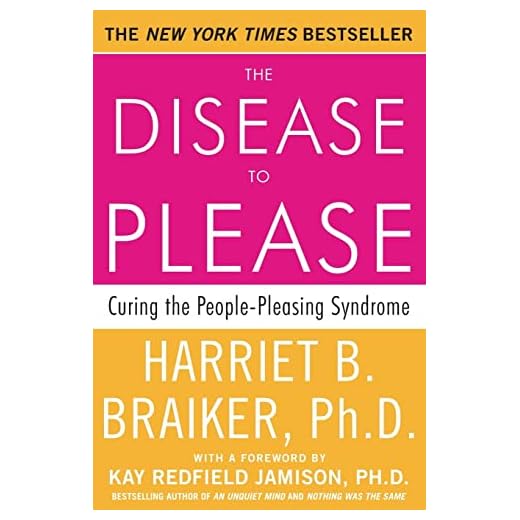
2 more titles round out our list, all shown in the quick picks above: The Disease to Please by Harriet B. Braiker (2001) — the ten commandments of pleasing, refuted one by one; The Assertiveness Workbook by Randy J. Paterson (2000) — the drills that turn reading into behavior.
How the top picks compare
|
Best overall
Set Boundaries, Find Peace
|
The classic
Boundaries
|
Best scripts
The Book of Boundaries
|
Best on the origin
Adult Children of Emotionally Immature Parents
|
Widest coverage
Where to Draw the Line
|
|
|---|---|---|---|---|---|
|
|
|
|
|
|
|
| Our rating | 9.1 /10 | 8.8 /10 | 8.6 /10 | 9.0 /10 | 8.3 /10 |
| Format | Psychology / self-help | Self-help / classic | Self-help | Psychology | Self-help |
| First published | 2021 | 1992 | 2022 | 2015 | 2000 |
| Price | $10.58 | $11.78 | $16.57 | $10.21 | $10.65 |
| BUY NOW | BUY NOW | BUY NOW | BUY NOW | BUY NOW |
How to choose a boundaries book
-
Symptom or sourceSome readers need scripts for next Tuesday; others need the origin story.Look forTawwab and Urban for immediate language; Gibson when the difficulty is older than the current relationship.AvoidCollecting scripts while the childhood training stays unexamined — the sentence fails if saying it still feels like betrayal.
-
Your failure modeOver-giving, over-explaining, and exploding are different collapses.Look forBraiker and Gazipura for compulsive pleasing; Paterson if you swing between silence and blowups and need the assertive middle.AvoidMistaking aggression for boundaries — the literature is unanimous that a boundary is calm information, not a counterattack.
-
Tolerance for discomfortEvery approach runs through guilt; books differ in how they coach it.Look forAuthors who normalize the guilt phase and give maintenance plans — stating the boundary is the start, keeping it is the skill.AvoidExpecting the other person's approval as the success metric — the boundary is kept by your follow-through, not their applause.
How we chose these books
-
Firsthand reading
Rankings start from our editors’ full reads of every title on the list — including the slow middles and the failed first attempts — not from publisher copy.
-
Reader-review analysis
We mined verified-purchase reviews, Goodreads consensus, and Reddit reading threads for recurring, specific complaints: print size, abridgments, translation quality, abandonment points.
-
Edition comparison
Where multiple translations or editions exist, we compared them and linked the printing most readers should actually buy — and flagged the known trade-offs.
Which boundaries book should I read first?
Set Boundaries, Find Peace — clearest system, best scripts, therapist’s steadiness about the guilt. Add Gibson’s Adult Children of Emotionally Immature Parents if family history is where your no goes to die.
Why do I feel so guilty setting boundaries?
Because you were likely trained that other people’s comfort is your job — so a healthy limit registers as a violation. The literature’s consensus: the guilt is withdrawal from an old role, not evidence of wrongdoing. It fades with repetition, and it fades faster when you expect it.
What if people get angry at my boundaries?
Some will — usually the ones who benefited from your lack of them. A boundary is what you will do, not what they must accept, so their anger doesn’t void it. Watch for the difference between someone adjusting to the new arrangement and someone punishing you for it; the second is its own information.
Aren't boundaries just selfishness with better branding?
No — the responsibility distinction answers this. You remain responsible to others: honesty, kindness, keeping your word. You stop being responsible for what only they can carry: their feelings, choices, and reactions to your limits. Chronic self-abandonment doesn’t make you generous; it makes you resentful, and resentment is worse for your relationships than any no.
Bottom line
Tawwab for the modern system, Cloud and Townsend for the classic architecture, Gibson for the origin, Urban for the exact words. A boundary is information about what you’ll do — stated calmly, kept by you, and guilt-tolerant by design.