The Best CBT Workbooks: Real Skills Practice You Can Do at Home
CBT is the most researched form of psychotherapy, and it has a property most therapies don't: its core skills can be practiced from a workbook, and studies show structured self-help versions genuinely help mild-to-moderate depression and anxiety. The catch is that workbooks only work written-in. Eight picks, ranked.
The best CBT workbook is Mind Over Mood — the standard thought-record training used in clinics worldwide, with the strongest evidence behind a self-help workbook. Burns’s Feeling Good Handbook is the richest companion, and Bourne’s Anxiety and Phobia Workbook the pick when anxiety is the primary target.
- Workbooks work — if you write in them The evidence for guided self-help CBT is real, and it’s dose-dependent: the benefit comes from completed worksheets and behavioral experiments, not from reading about them.
- Match the workbook to the problem Mind Over Mood is the general-purpose standard; Bourne owns anxiety and phobias; the DBT and ACT workbooks serve emotion dysregulation and stuck avoidance respectively.
- Self-help has limits Moderate-to-severe depression, trauma, and suicidal thinking need a clinician — every good workbook says so itself, and the honest ones say it early.
This guide is part of our books for therapists silo — clinicians assign these workbooks between sessions, trainees learn the techniques from them, and self-directed readers use them as the closest thing to CBT without a therapist.
Why CBT translates to paper better than other therapies
CBT’s premise is teachable: moods follow interpretations, interpretations can be examined, and behavior change feeds back into both. Its core tools — the thought record, behavioral activation, graded exposure — are structured procedures a motivated person can run on themselves, which is why CBT dominates the self-help evidence base. Trials of guided self-help — workbook plus minimal therapist contact — show effects approaching full therapy for mild-to-moderate depression and anxiety; Mind Over Mood and Burns’s Feeling Good program are the books most often used in that research.
The honest caveats: unguided self-help has higher dropout, severity matters — a workbook is the wrong tool for severe depression, trauma, or any safety concern — and completion is everything. The seven-column thought record looks trivial until you do thirty of them, which is roughly when the skill moves from the page into the reflexes. Buy a pencil with the book; the marginal reader gets the marginal result.
Which workbook for which problem
General low mood, self-criticism, mixed anxiety: Mind Over Mood, full stop — the clearest thought-record training in print, used as clinic homework worldwide. Burns’s Feeling Good Handbook covers similar ground more discursively, with the most persuasive writing on cognitive distortions ever aimed at a lay reader. For anxiety specifically — panic, phobias, worry — Bourne’s Anxiety and Phobia Workbook is the encyclopedic standard, and Carbonell’s Worry Trick the sharpest short treatment of the worry loop itself. Gillihan’s Retrain Your Brain is the pick for structure-lovers: seven weeks, laid out day by day.
Two adjacent traditions earn their places. The DBT Skills Workbook adapts dialectical behavior therapy’s modules — mindfulness, distress tolerance, emotion regulation, interpersonal effectiveness — for readers whose problem is emotional storms more than distorted thoughts. And Hayes’s Get Out of Your Mind and Into Your Life brings ACT’s counterintuitive move: stop arguing with thoughts, unhook from them, and steer by values instead — the workbook for people exhausted by their own disputation. Knaus’s depression workbook rounds out the shelf for readers whose target is specifically the low-mood spiral.
Independently researched and ranked by our editorial team. As an Amazon Associate, this site earns from qualifying purchases made through the links below.





#1: Mind Over Mood — Best overall
Dennis Greenberger & Christine A. Padesky
The seven-column thought record taught step by step, plus behavioral experiments and mood tracking — the workbook with the strongest evidence and the widest clinical use.
- The standard CBT workbook — worksheets clinicians actually assign
- Thought records taught step by step, with worked examples
- Covers depression and anxiety in one volume; second edition is substantially improved
- A workbook, not a read — it only works if you write in it
- Dry; motivation must come from elsewhere
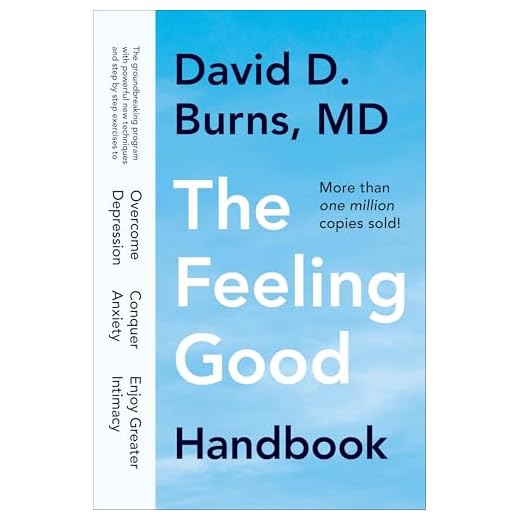
#2: The Feeling Good Handbook — Richest companion
David D. Burns
Burns’s expansive follow-up to Feeling Good — distortions, mood logs, communication, and procrastination — with the most convincing prose in the CBT canon. Discursive where Padesky is structured.
- The most persuasive writing on cognitive distortions ever aimed at a lay reader
- Expands beyond mood into communication, anxiety, and procrastination
- Burns’s voice — confident, warm, evangelical for the method — carries reluctant readers
- The distortion checklist alone has entered the culture
- Discursive where Padesky is structured — less workbook, more book
- The 1999 edition shows its age in examples and evidence citations
#3: The Anxiety and Phobia Workbook — Best for anxiety
Edmund J. Bourne
Relaxation, exposure hierarchies, interoceptive work, thought challenging, lifestyle — every anxiety tool in one thick manual, updated across seven editions. The anxiety shelf’s reference.
- Encyclopedic — panic, phobias, worry, OCD, and the whole tool chest in one manual
- Exposure hierarchies and interoceptive work laid out step by step
- Seven editions of refinement; the anxiety shelf’s standing reference
- Strong lifestyle chapters — breath, exercise, caffeine — the basics done properly
- Thickness intimidates; it’s a reference to raid, not a program to march through
- Coverage breadth means depth varies by chapter
#4: Retrain Your Brain: CBT in 7 Weeks — Best structured program
- The clearest structure on the shelf — seven weeks, laid out day by day
- Warm, unpatronizing voice unusual in structured programs
- Covers both depression and anxiety in one sequence
- The lowest-friction serious workbook — completion rates reflect it
- Seven weeks is a beginning, not a cure — maintenance needs planning past the program
- Less depth per topic than the dedicated volumes
#5: The Dialectical Behavior Therapy Skills Workbook — Best for emotion storms
Matthew McKay, Jeffrey C. Wood & Jeffrey Brantley
Distress tolerance, mindfulness, emotion regulation, interpersonal effectiveness — the standard self-guided DBT manual for readers whose problem is intensity more than interpretation.
- DBT’s four modules — mindfulness, distress tolerance, emotion regulation, interpersonal effectiveness — in workable self-help form
- The right tool when the problem is emotional intensity rather than distorted thinking
- Crisis-survival skills that work the same night you read them
- Progressive exercises that build rather than repeat
- Self-guided DBT lacks the coaching and group components the full therapy relies on
- Dry workbook prose; the skills carry it, not the voice
#6: Get Out of Your Mind and Into Your Life — Best ACT workbook
Steven C. Hayes
ACT’s founder walks the reader through acceptance, defusion, and values-based action — the workbook for people for whom thought-challenging became another form of struggle.
- ACT from its founder — acceptance, defusion, and values-based action, exercise by exercise
- The right book when thought-challenging has become another form of struggle
- The defusion exercises produce fast, strange, real relief
- Values work gives the whole program a direction most workbooks lack
- ACT’s counterintuitive moves take faith before they take effect
- Denser and odder than standard CBT fare — some readers need a gentler ACT intro
2 more titles round out our list, all shown in the quick picks above: The Cognitive Behavioral Workbook for Depression by William J. Knaus (2012) — the depression-specific deep dive; The Worry Trick by David A. Carbonell (2016) — the worry loop dismantled in plain language.
How the top picks compare
|
Best overall
Mind Over Mood
|
Richest companion
The Feeling Good Handbook
|
Best for anxiety
The Anxiety and Phobia Workbook
|
Best for emotion storms
The Dialectical Behavior Therapy Skills Workbook
|
|
|---|---|---|---|---|
|
|
|
|
|
|
| Our rating | 9.2 /10 | 8.9 /10 | 8.9 /10 | 8.6 /10 |
| Format | CBT workbook | CBT workbook | Anxiety workbook | CBT workbook |
| First published | 2015 | 1999 | 2020 | 2016 |
| Price | $15.44 | $14.72 | $21.92 | $20.00 |
| BUY NOW | BUY NOW | BUY NOW | BUY NOW |
How to choose a CBT workbook
-
Your primary targetDepression, anxiety, emotion dysregulation, and chronic worry pull toward different books.Look forMind Over Mood for general use, Bourne for anxiety, the DBT workbook for emotional intensity, Hayes when fighting thoughts has itself become the problem.AvoidBuying three workbooks at once — one book completed beats a shelf of chapter ones.
-
Structure appetiteSome readers need a syllabus; others want a reference to raid.Look forGillihan's seven-week schedule if you thrive on sequence; Bourne or Burns if you'd rather work by chapter as needs arise.AvoidMistaking reading for practice — the evidence is for completed worksheets, and skimming produces the placebo version.
-
Severity and safetyWorkbooks are for mild-to-moderate problems, alone or alongside therapy.Look forA clinician first if depression is severe, trauma is central, or safety is in question — then workbooks as adjuncts.AvoidTreating a workbook as a therapy substitute when functioning is seriously impaired; every good author on this list says the same.
How we chose these books
-
Firsthand reading
Rankings start from our editors’ full reads of every title on the list — including the slow middles and the failed first attempts — not from publisher copy.
-
Reader-review analysis
We mined verified-purchase reviews, Goodreads consensus, and Reddit reading threads for recurring, specific complaints: print size, abridgments, translation quality, abandonment points.
-
Edition comparison
Where multiple translations or editions exist, we compared them and linked the printing most readers should actually buy — and flagged the known trade-offs.
Which CBT workbook should I start with?
Mind Over Mood for most people — the thought-record training is the core CBT skill, and no book teaches it better. If anxiety is clearly the main problem, start with Bourne’s Anxiety and Phobia Workbook instead; if you want a scheduled program, Gillihan’s seven-week book.
Do CBT workbooks actually work without a therapist?
For mild-to-moderate depression and anxiety, yes — trials of self-help CBT show real effects, strongest when there’s some guidance and the exercises actually get done. Completion is the active ingredient. For severe symptoms, trauma, or any safety concern, a clinician comes first.
What's the difference between CBT, DBT, and ACT workbooks?
CBT examines and tests thoughts; DBT builds skills for surviving and regulating intense emotion; ACT drops the argument with thoughts entirely and steers by values. Rough guide: distorted thinking → CBT, overwhelming feelings → DBT, exhausting mental struggle → ACT.
How long does a CBT workbook take?
Structured programs like Gillihan’s run seven weeks; Mind Over Mood rewards two to four months of weekly practice. The skill milestone is unglamorous: several dozen completed thought records, at which point the questioning starts happening automatically. Speed matters less than actually writing.
Bottom line
Mind Over Mood as the default, Bourne for anxiety, the DBT workbook for emotional storms, Hayes for the over-thinkers. Buy the pencil, do the worksheets, and get a clinician involved when severity says so.