Erich Fromm Books Guide: Where to Start with the Art of Loving Author
Erich Fromm fused Freud with social criticism and wrote some of the century's most humane psychology — then popularity cost him the academic respect he's only now regaining. Here's the map: eight books, the order to read them, and what each one actually argues.
Start Erich Fromm with The Art of Loving (1956) — his shortest, most famous book and the clearest door into his thought. Read Escape from Freedom next: his 1941 masterpiece on why people flee freedom into authoritarianism. Then To Have or To Be? delivers the late, wise summation of everything he argued.
- Start short, then go deep The Art of Loving is 120 pages and fully representative — Escape from Freedom is the masterpiece standing behind it.
- One system, many books The character orientations of Man for Himself run beneath everything he wrote — spot the system and the books click together.
- Psychology plus society Fromm’s signature move is diagnosing cultures rather than only patients — closer to the existential tradition this site covers than to Freud’s couch.
This guide is part of our great minds of psychology silo — Fromm sits between Freud, whom he revised, and the humanistic psychology he anticipated.
Who Fromm was — and why the academy dropped him
Fromm trained as a psychoanalyst in the Frankfurt School’s orbit, then spent fifty years asking one question at increasing scale: what does a society do to the people who must adapt to it? Escape from Freedom (1941) answered it for fascism; The Sane Society (1955) turned the same diagnostic eye on postwar consumer democracy and asked whether an entire culture could be, in his phrase, insane.
His crime, academically, was being read. The Art of Loving sold in the millions, and the analytic establishment concluded that anything that popular must be shallow. The verdict is being reversed: his analysis of authoritarianism is assigned again, and his having-versus-being distinction reads today like a diagnosis written in advance. He remains the most quotable serious psychologist of his century.
The reading order that makes the system visible
Begin with The Art of Loving — not because it is lightest but because it is the whole system in miniature: love as practiced art rests on the “productive character” he built formally in Man for Himself. Then read Escape from Freedom, where the machinery is at full power — the three escape mechanisms it describes (authoritarianism, destructiveness, conformity) organize every book that follows.
After those two, choose by appetite: To Have or To Be? for the late spiritual summation, The Sane Society for the social criticism, The Anatomy of Human Destructiveness for the 700-page magnum opus on human evil — his deepest and most demanding work, best saved for last. Yalom readers will find the existential concerns familiar: separateness, freedom, and the flight from both.
Independently researched and ranked by our editorial team. As an Amazon Associate, this site earns from qualifying purchases made through the links below.
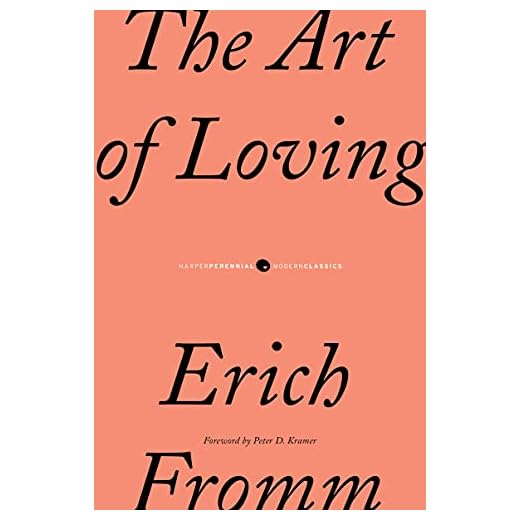


#1: The Art of Loving — Start here
Erich Fromm
The 1956 classic arguing that love is a practiced art, not a feeling that happens to you — rooted in the human condition of separateness. Dated in spots, permanent at its core.
- The classic argument that love is a practiced art, not a feeling that happens to you
- 120 pages, clear and permanently quotable
- Grounds love in the human condition — separateness and its answers
- Continuously in print since 1956 for good reason
- Mid-1950s assumptions about gender and sexuality show their age badly in places
- The ‘practice’ section is surprisingly brief for a book about practice
#2: Escape from Freedom — The masterpiece
Erich Fromm
Written in 1941 and never once out of relevance since — why freedom frightens people, and the three escape routes they take from it. His most important book.
- The essential analysis of why people flee freedom into authoritarianism
- Written in 1941; its relevance has never once lapsed since
- Fuses psychoanalysis with social and economic history — Fromm’s signature move
- The masterpiece that everything else he wrote elaborates
- Denser and more academic than his later popular books
- Mid-century psychoanalytic framing requires some translation by the reader
#3: To Have or To Be? — The late summation
Erich Fromm
His last major statement — possession versus presence as two modes of existence, and consumer culture as the having mode institutionalized. The Fromm book that reads most like a wisdom text.
- The having-versus-being distinction organizes consumer culture in a single move
- Late Fromm at his most spiritual and accessible
- Short chapters; reads like a wisdom text more than a treatise
- The utopian social program in the final section has aged poorly
- Repeats arguments from earlier books for readers who know them
#4: The Sane Society — The social diagnosis
Erich Fromm
Can a whole society be sick? Fromm’s 1955 answer built the diagnostic kit — alienation, the marketing orientation, the socially patterned defect — that critics still borrow.
- Turns the diagnostic eye from the patient to the whole society
- The concept of the ‘socially patterned defect’ is permanently useful
- The fullest bridge between his psychology and his social criticism
- The longest and most uneven of his major books
- 1950s data, examples, and targets throughout
#5: Man for Himself — The system itself
Erich Fromm
His most rigorous work — the character orientations laid out formally, with the productive character as the goal. Drier than the famous books and the key to all of them.
- His most systematic book — the character orientations laid out in full
- The ‘productive character’ here is the key that unlocks all his later work
- Rigorous where the later books are lyrical
- The driest of his major works
- The typology can feel schematic if read in isolation
#6: The Anatomy of Human Destructiveness — The magnum opus
- His deepest work — aggression, sadism, and destructiveness as character, not instinct
- The Hitler case study is a landmark of psychobiography
- Engages the ethology debates of its era head-on rather than dismissing them
- Nearly 700 pages — by far his most demanding book
- Some of the biology he argues against has itself been superseded, dating both sides
How to choose your Fromm
-
Length of runwayFromm wrote both 120-page doors and 700-page cathedrals.Look forThe Art of Loving or To Have or To Be? as short doors; Escape from Freedom when you're ready to stay.AvoidStarting with The Anatomy of Human Destructiveness — 700 pages is a poor first date.
-
Psychology or social criticismHis books tilt personal or cultural, though the system is one.Look forArt of Loving and Man for Himself for the person; Escape from Freedom and The Sane Society for the culture.AvoidExpecting clinical technique — Fromm diagnoses conditions, not patients.
-
Edition currencyFromm's backlist has cycled through many publishers.Look forIn-print Harper, Holt, Continuum or Open Road editions with named publishers.AvoidPrint-on-demand copies with no publisher listed and reflowed, error-ridden text.
How we chose these books
-
Firsthand reading
Rankings start from our editors’ full reads of every title on the list — including the slow middles and the failed first attempts — not from publisher copy.
-
Reader-review analysis
We mined verified-purchase reviews, Goodreads consensus, and Reddit reading threads for recurring, specific complaints: print size, abridgments, translation quality, abandonment points.
-
Edition comparison
Where multiple translations or editions exist, we compared them and linked the printing most readers should actually buy — and flagged the known trade-offs.
Which Erich Fromm book should I read first?
The Art of Loving — 120 pages, fully representative, and the clearest statement of his central idea: that love is a discipline resting on a developed character, not a feeling that happens to you. Escape from Freedom should follow it.
What is Escape from Freedom about?
Why freedom frightens people. Fromm argues that modern freedom brought isolation along with independence, and that people flee the burden through three routes — submission to authority, destructiveness, or automaton conformity. Written in 1941, it remains the standard psychological account of authoritarianism’s appeal.
Is Erich Fromm still taken seriously?
Increasingly, yes. His popularity once cost him academic standing, but his work on authoritarianism is widely assigned again, and the having-versus-being framework anticipated the modern critique of consumer identity. The reappraisal is well underway.
Was Fromm a Freudian?
A revisionist one. He kept Freud’s depth psychology but rejected instinct as the engine, replacing it with the relationship between character and society. His humanistic emphasis — freedom, love, self-realization — makes him a bridge between psychoanalysis and the existential-humanistic tradition this site covers.
Bottom line
Start with The Art of Loving, stay for Escape from Freedom, and let Man for Himself show you the system underneath. To Have or To Be? is the late reward; the Anatomy is the mountain for whoever wants the whole Fromm.