Freud Books: Where to Start (A Reader’s Guide)
Freud wrote twenty-four volumes, and most people who try to read him start in the wrong place and stop. This guide ranks the six books that actually work for modern readers — with honest warnings about the ones that don't.
Start Freud with Peter Gay’s The Freud Reader, the best guided anthology, or with Civilization and Its Discontents, his most readable major work. Save The Interpretation of Dreams for later — it is historically essential but long. Anthony Storr’s Very Short Introduction is the ideal two-hour primer.
- Anthology beats guessing The Freud Reader curates the whole system with expert introductions — the safest first purchase.
- Short Freud is best Freud Civilization and Its Discontents and The Psychopathology of Everyday Life deliver the ideas without the 700-page commitment.
- Read him as literature and history Much of the science hasn’t survived; the questions, the prose, and the influence absolutely have.
This guide is part of our great minds of psychology series — Yalom trained in the psychoanalytic world Freud built, then spent a career revising it.
Why read Freud at all in 2026?
Be honest about the terms: as science, large parts of Freud have not survived — the developmental stages, the dream-as-wish doctrine, the energy hydraulics. What survives is bigger: the unconscious as a working idea, defense mechanisms, transference, the talking cure itself, and a prose style that won him a major literary prize. You read Freud the way you read Darwin — as the source of a vocabulary the culture still thinks in.
For readers coming from Yalom, the connection is direct: Yalom trained as a psychoanalytically-informed psychiatrist and kept Freud’s deep listening while swapping the drives for existential concerns. Love’s Executioner is unimaginable without the case-history form Freud invented.
The classic mistake: starting with The Interpretation of Dreams
It sounds like the obvious entry — the famous one, the founding text. In practice it defeats more readers than any other Freud book: the opening chapter is a 90-page review of nineteenth-century dream literature, and the argument doesn’t ignite until chapter two. If you must start there, skip chapter one without guilt.
The kinder path: a short real text first (Civilization and Its Discontents or The Psychopathology of Everyday Life), the Storr primer alongside, and the Reader when you’re hooked. The big dream book rewards you far more once you already speak some Freud.
Independently researched and ranked by our editorial team. As an Amazon Associate, this site earns from qualifying purchases made through the links below.



#1: The Freud Reader — Best starting point
Sigmund Freud (ed. Peter Gay)
Peter Gay’s guided anthology — dreams, cases, culture and technique across 800 pages, with the best short orientation to Freud in print as its introduction.
- Peter Gay’s selection covers the full arc — dreams, sexuality, culture, technique — in one volume
- Gay’s general introduction is one of the best short orientations to Freud in print
- Uses the standard Strachey translations, so quotes match what scholars cite
- At nearly 800 pages it’s physically unwieldy — not a commute book
- Excerpting means some arguments (especially from the metapsychology papers) arrive mid-stream
#2: Civilization and Its Discontents — Best single work
Sigmund Freud
The short, forceful late essay: civilization demands we renounce instinct, and the bill arrives as unhappiness. Freud’s most readable and most argued-about book.
- Freud’s most readable major work — a short, forceful essay rather than clinical theory
- The core argument (civilization demands instinct-renunciation, which breeds unhappiness) still drives debates today
- The Norton edition’s Gay introduction and footnotes earn their price over free e-texts
- Assumes you accept drive theory — skeptical readers may want a primer first
- Pessimistic to the point of bleakness; not a book to hand someone in a fragile moment
#3: The Interpretation of Dreams — The founding text
Sigmund Freud
Where psychoanalysis begins — Freud analyzing his own dreams in print. Essential, personal, and much longer than it needs to be; skip the literature-review first chapter.
- The founding document of psychoanalysis — the dream-work concepts (condensation, displacement) start here
- Freud’s own dreams, analyzed in print, make it unexpectedly personal and candid
- Joyce Crick’s Oxford translation is brisker and more modern than Strachey’s for first-time readers
- Chapter 1’s 90-page literature review stops many readers before the book starts — skim it
- Long, repetitive middle sections; most readers’ takeaways come from chapters 2, 4 and 6
- Translation choice matters: Strachey (Basic Books) is standard for citation, Crick is easier to read
#4: The Psychopathology of Everyday Life — Most accessible
Sigmund Freud
The origin of the Freudian slip — forgotten names, bungled actions and slips of the tongue, analyzed case by case. The friendliest door into how Freud actually thinks.
- The origin of the ‘Freudian slip’ — slips, forgotten names and bungled actions analyzed case by case
- The most accessible entry to Freud’s method: everyday examples instead of clinical cases
- Short chapters make it a natural dip-in book
- The examples pile up long after the point is made — the second half feels padded
- Many word-play examples work only in German; footnotes have to rescue them
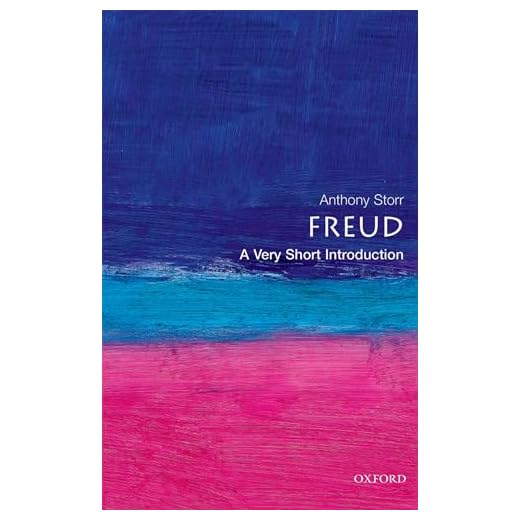
#5: Freud: A Very Short Introduction — Best primer
Anthony Storr
Storr’s pocket guide is sympathetic and critical at once — what Freud claimed, what survives scrutiny, and why he matters anyway. Read it and everything else lands better.
- Anthony Storr is both sympathetic and critical — he separates what survives scrutiny from what doesn’t
- Covers the life, the theory and the legacy in about 160 pocket-sized pages
- Honest about the scientific standing of psychoanalysis, which most primers dodge
- Necessarily compressed — case histories get a paragraph each
- Storr’s own psychiatric perspective colors some judgments; it’s an interpretation, not a neutral survey
#6: Beyond the Pleasure Principle — For the committed
Sigmund Freud
The strange, short pivot where Freud proposes the death drive — his most speculative book, and the hinge to everything late. Read it fourth or fifth, never first.
- The pivot text where Freud introduces the death drive and repetition compulsion
- Short (about 80 pages) — the fastest way into late Freudian theory
- Watching Freud argue against his own earlier system is intellectually gripping
- The most speculative Freud — even sympathetic readers find the biology sections hand-wavy
- Assumes fluency in his earlier drive theory; a poor first Freud book
How to choose your first Freud book
-
Commitment levelFreud ranges from 60-page essays to 800-page volumes.Look forA short real text (Civilization) or the primer first; the Reader once committed.AvoidOpening The Interpretation of Dreams cold — its first chapter ends most attempts.
-
Translation and editionThe Strachey Standard Edition texts are the scholarly norm; newer translations read easier.Look forNorton editions (Gay introductions) for the standard texts; Oxford's Crick translation for Dreams.AvoidFree public-domain e-texts of the older Brill translations — noticeably worse.
-
Your reason for readingHistory-of-ideas readers and self-understanding readers need different Freud.Look forCulture essays (Civilization) for ideas; Psychopathology and the case histories for the method.AvoidReading Freud as current clinical science — treat him as a foundational thinker instead.
How we chose these books
-
Firsthand reading
Rankings start from our editors’ full reads of every title on the list — including the slow middles and the failed first attempts — not from publisher copy.
-
Reader-review analysis
We mined verified-purchase reviews, Goodreads consensus, and Reddit reading threads for recurring, specific complaints: print size, abridgments, translation quality, abandonment points.
-
Edition comparison
Where multiple translations or editions exist, we compared them and linked the printing most readers should actually buy — and flagged the known trade-offs.
What is the best Freud book to start with?
Either The Freud Reader — Peter Gay’s guided anthology of the whole system — or Civilization and Its Discontents if you want one short, complete work. Most readers should not start with The Interpretation of Dreams despite its fame.
Is Freud still worth reading if his science is outdated?
Yes — read him as you would Darwin or Marx: a foundational thinker whose vocabulary (the unconscious, repression, transference, denial) the culture still uses daily. The case histories and cultural essays also stand as remarkable literature.
Which translation of Freud should I buy?
The Strachey translations (Norton/Standard Edition) are what scholars cite and the safe default. For The Interpretation of Dreams specifically, Joyce Crick’s Oxford translation is brisker and easier for a first reading.
How does Freud connect to Irvin Yalom?
Yalom trained in Freud’s tradition and kept its deep listening, its case-history form, and its respect for the unconscious — while replacing the drive theory with four existential concerns: death, freedom, isolation, and meaninglessness.
Bottom line
The Reader if you’ll buy one book; Civilization and Its Discontents if you want one short masterpiece; the Storr primer if you want a map first. Save the dream book for when you’re hooked — and skip its first chapter when you get there.