Viktor Frankl’s Books in Order: The Complete Reading Path
Viktor Frankl wrote one book nearly everyone has heard of — and a dozen most readers never find. Here is the complete reading path through logotherapy's founder, in the order that actually builds.
Start Viktor Frankl with Man’s Search for Meaning (1946), the memoir-plus-theory classic. Then read The Doctor and the Soul for the full logotherapy system, Yes to Life for the newly recovered 1946 lectures, and The Will to Meaning for the mature theory. His essay collections come last.
- One unmissable book Man’s Search for Meaning is the entry point for everyone — memoir first, theory second, four hours of reading.
- Then the system The Doctor and the Soul and The Will to Meaning turn the memoir’s insight into an actual therapeutic method.
- Late essays are optional The essay collections repeat the core ideas — for completists and practitioners, not first-timers.
This reading path is part of our best existential therapy books silo, where Frankl’s meaning-centered school sits alongside Yalom’s and May’s.
Do you need to read Frankl in order?
Only loosely. Man’s Search for Meaning is self-contained and belongs first for everyone — it earns your trust before the theory asks for it. After that, the order is about depth, not plot: The Doctor and the Soul is the systematic textbook Frankl himself considered his main work, and everything later refines it.
A useful shortcut: Yes to Life, the rediscovered 1946 lectures, covers the same ground as the famous memoir in a warmer spoken voice. Some readers now recommend it as a companion first read — two short books from the same astonishing year.
Memoir, system, essays: the three shelves of Frankl
Frankl’s bibliography sorts into three shelves. The memoir shelf is Man’s Search for Meaning and Yes to Life — testimony from the camps plus the meaning philosophy in embryo. The system shelf is The Doctor and the Soul and The Will to Meaning, where logotherapy becomes an actual clinical method with techniques like paradoxical intention.
The essay shelf — Man’s Search for Ultimate Meaning, The Unheard Cry for Meaning — extends the system into religion, sport, and the boredom of affluent societies. These overlap heavily with each other; read them when you already know you want more Frankl, not before.
Independently researched and ranked by our editorial team. As an Amazon Associate, this site earns from qualifying purchases made through the links below.




#1: Man's Search for Meaning — Start here
Viktor E. Frankl
The Holocaust memoir and meaning-theory in one slim volume — among the most influential books of the twentieth century, and still the best four hours in psychology reading.
- First-person Holocaust testimony fused with a psychiatry of meaning — there is nothing else like it
- Short (about 165 pages); part one can be read in a single sitting and rarely lets go
- The core claim — a ‘why’ makes almost any ‘how’ bearable — has held up in palliative and trauma care
- The Beacon edition includes Frankl’s 1984 postscript on tragic optimism
- Verified buyers regularly complain the Beacon mass-market printing has small, tight type — pick the larger trade paperback if your eyes are older
- Part two, the logotherapy lecture, is far drier than the memoir; many readers stall there
- Light on method — it tells you meaning matters, not how a session works
#2: The Doctor and the Soul — The system
Viktor E. Frankl
Frankl’s systematic statement — from the meaning of work and love to the clinical techniques. The book he smuggled through the camps as a manuscript and rewrote from memory.
- Frankl’s fullest clinical statement — the medical book behind the memoir
- Dedicated chapters on the meaning of work, love, and suffering that MSFM only sketches
- Shows logotherapy applied to real diagnostic categories, not just extreme suffering
- Mid-century Viennese academic prose — formal, slow, and repetitive by modern standards
- The translation preserves the original’s dense structure; readers call it a study text, not a bedside one
- Case material is brief compared with what modern readers expect
#3: Yes to Life: In Spite of Everything — Best companion
Viktor E. Frankl
Three lectures given eleven months after liberation, unpublished in English until 2020. The memoir’s ideas in a live, direct voice — with a superb Daniel Goleman introduction.
- Three lectures delivered in 1946, months after liberation — the historical immediacy is the point
- Short enough for one evening; the most accessible Frankl after MSFM
- Daniel Goleman’s introduction sets the historical context well
- Overlaps heavily with Man’s Search for Meaning — buyers often report half of it feels familiar
- These are transcribed lectures, looser and less polished than his written books
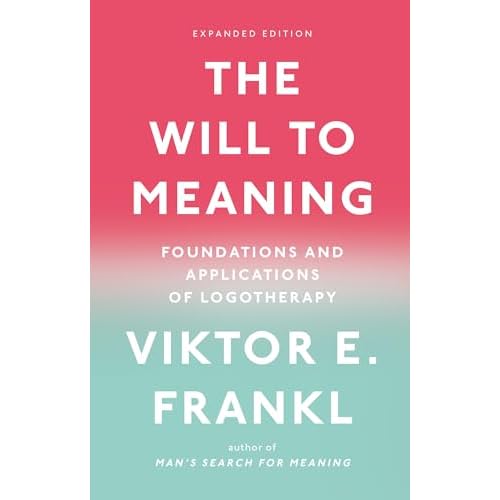
#4: The Will to Meaning — Mature theory
Viktor E. Frankl
The tightest statement of logotherapy’s principles — meaning as the primary human motivation, and what follows for therapy. The best single theory book after the memoir.
- The most systematic statement of logotherapy’s foundations and its answer to Freud and Adler
- Short — the theory without the 400-page commitment
- The 2014 Plume reissue is the easiest edition to find and read
- Assumes you have already read Man’s Search for Meaning
- Compiled partly from lectures, so key points repeat across chapters
- Abstract throughout — almost no extended case material
#5: Man's Search for Ultimate Meaning — The spiritual side
Viktor E. Frankl
Frankl on the unconscious God — where logotherapy meets religious experience. The expanded late-career revision of his 1948 lectures.
- Extends logotherapy into religion and the unconscious — the questions the other books avoid
- A late-career synthesis, with Frankl revisiting his own system after fifty years
- The chapter on the ‘unheard cry for meaning’ connects directly to modern meaning-centered therapy
- The most academic Frankl — general readers regularly describe it as heavy going
- It is a revision of the earlier The Unconscious God, and parts read recycled
- The weakest starting point in his catalog; keep it for last
#6: The Unheard Cry for Meaning — For completists
Viktor E. Frankl
Essays applying meaning-theory to sport, humor, sex and the boredom of affluence — Frankl responding to the 1970s rather than the 1940s.
- Extends logotherapy into everyday territory — sports, humor, sex — showing how meaning applies beyond suffering
- The chapters on ‘unheard cries’ in affluent societies feel more relevant now than when written in 1978
- Shorter, essay-based format makes it easy to read one chapter at a time
- Essays overlap noticeably with The Will to Meaning — readers of both report repetition
- Some cultural references (1970s counterculture, encounter groups) have dated badly
How to choose your next Frankl book
- Where you are in the path
Frankl builds: memoir, then system, then essays.
Look forMan's Search for Meaning first; The Doctor and the Soul when you want the method.AvoidStarting with the essay collections — they assume the system. - Edition and translation
Frankl’s books have been revised and re-translated repeatedly across 70 years.
Look forThe Beacon Press Man's Search for Meaning (foreword by Harold Kushner) — the current standard.AvoidOld mass-market printings that omit the 1984 postscript on tragic optimism. - Overlap tolerance
Frankl reused lecture material; the later books repeat the core ideas.
Look forOne book per shelf — memoir, system, essays — for the full picture without duplication.AvoidBuying both essay collections expecting different arguments.
What order should I read Viktor Frankl's books in?
Man’s Search for Meaning first, then The Doctor and the Soul, Yes to Life, and The Will to Meaning. The later essay collections — Man’s Search for Ultimate Meaning, The Unheard Cry for Meaning — are for readers who want to go deeper into logotherapy.
What is logotherapy in one sentence?
Logotherapy is Frankl’s school of psychotherapy built on the claim that the primary human drive is not pleasure or power but meaning — and that meaning can be found in work, in love, and in the stance we take toward unavoidable suffering.
Is Yes to Life worth reading after Man's Search for Meaning?
Yes — it covers similar ground but in the spoken voice of lectures Frankl gave in 1946, and it is short enough to read in an evening. Many readers find its directness the perfect companion to the memoir.
How is Frankl different from Yalom?
Frankl says meaning is out there to be discovered — through work, love, and courage in suffering. Yalom says the universe offers no built-in meaning and we must create our own. Same existential concern, opposite answers; reading both is the fastest way to find your own position.
Bottom line
Read Man’s Search for Meaning first — no exceptions. Add Yes to Life for the same year in a warmer voice, The Doctor and the Soul for the system, and The Will to Meaning for the mature theory. The essay collections are dessert, not dinner.