Attached book summary: what Levine and Heller claim, and where the science is more careful
Attached, by the psychiatrist Amir Levine and the psychologist Rachel Heller, first appeared in 2010 and is still the book most people mean when they talk about having an anxious or avoidant style.
Its pitch is simple: decades of research on how infants bond with caregivers can explain why some adults crave closeness, others back away from it, and a third group seems to find love easy. This guide sets out what the book claims, how it is built, what readers tend to take from it, and where it pares the research down further than the evidence allows. It ends with the books worth reading next.
Attached argues that adults fall into three attachment styles, anxious, avoidant and secure, and that much relationship misery comes from an anxious person and an avoidant person locking each other into a cycle of pursuit and retreat. It is clear and memorable, and readers often recognise a past relationship in it. Its main weakness is that it presents the styles as types, when the research treats them as tendencies on two dimensions that shift across relationships and over time.
What Attached by Levine and Heller sets out to do
The book’s full subtitle promises to explain the new science of adult attachment and how it can help you find and keep love. That is an honest description of its ambition. Levine and Heller are not offering a new theory; they are translating an existing body of research, mostly from social and developmental psychology, into the language of dating and long-term partnership. Their argument is that the need for a dependable partner is not a weakness to be grown out of but a built-in feature of human beings, and that people differ mainly in how comfortable they are relying on someone and being relied on.
That framing explains the book’s lasting appeal. It removes some of the shame from wanting closeness, and it gives readers a vocabulary for patterns they had noticed but could not name. Like the other guides in our book summaries and study guides, this page tries to give you the shape of the book and enough context to decide whether it suits you, not a substitute for reading it.
How Attached is built, from self-assessment to breakups
The book moves in a clear arc. It opens with the case for taking attachment seriously in adult life and offers questionnaires for placing yourself and, from observed behaviour, a partner. The middle chapters take each style in turn, describing how it shows up in early dating, in conflict and in everyday contact. The later chapters turn to what happens when styles meet: the anxious and avoidant pairing, ways of talking about needs directly, and how to think about leaving a relationship that keeps you in a state of alarm.
Throughout, the authors lean on short case stories of couples and individuals, which is a large part of why the book reads quickly. The case stories are illustrations rather than evidence, and they are shaped to make each style recognisable. That is a fair choice for a popular book, but it means the categories can feel sharper on the page than they do in real lives.
Anxious, avoidant and secure in Attached's own terms
Attached describes three main styles and mentions a fourth, a fearful or anxious-avoidant combination, only briefly. Our explainer on the four attachment styles covers that fourth pattern and where all four came from; here the point is how Levine and Heller frame the three they build the book around. The book also gives rough estimates of how common each style is, with secure people the largest group; treat those figures as approximate, since they depend on which questionnaire and which sample you use.
| Style | What the book says it wants | Key term the book uses |
|---|---|---|
| Anxious | Closeness and reassurance, with high sensitivity to signs that a partner is pulling away | Activating strategies and protest behaviour: efforts to restore contact, from repeated messages to keeping score |
| Avoidant | Independence and self-sufficiency, with discomfort when a partner gets too close | Deactivating strategies: ways of creating distance, such as focusing on a partner’s flaws or idealising a past partner |
| Secure | Closeness without great worry about losing it, and comfort with being depended on | The secure partner as a stabiliser who can calm the other two styles |
The most quoted idea in this part of the book is what the authors call the dependency paradox: the claim, drawn from attachment research, that people who can count on a partner tend to be more confident and adventurous on their own, not less. It reverses the common advice that you should need nobody before you can love anybody, and it is the idea many readers say stayed with them longest.
The anxious-avoidant trap and Attached's dating-pool argument
The chapters on the anxious and avoidant pairing are the heart of the book and the part readers recognise most often. The cycle is easy to describe: one partner moves closer to feel safe, the other steps back to feel safe, and each step makes the other more determined. The authors argue that the highs and lows of this pattern are easily mistaken for passion, while a calm secure partner can seem dull at first.
They add a second, more provocative argument about dating itself. Secure people, they suggest, tend to pair off and stay paired, while avoidant people end relationships more readily and so return to the dating pool more often. If that is right, a single person will meet avoidant partners more often than their share of the population would predict. It is a neat piece of reasoning, and it gives many readers a sense of relief, but it is an inference from how the styles behave rather than a finding the book demonstrates with data of its own.
Where Attached oversimplifies the attachment research
The styles are tendencies, not types. Attachment theory began with John Bowlby’s work after the Second World War and Mary Ainsworth’s observational studies of infants with their mothers. The adult version came later: researchers in social psychology, starting in the late 1980s, asked whether the infant patterns had echoes in romantic love. Most of that adult research relies on self-report questionnaires, and the dominant approach scores people on two continuous dimensions, attachment anxiety and attachment avoidance. Someone can be a little anxious, quite avoidant, or neither, and their scores can differ from one relationship to another. Attached sorts people into boxes because boxes are easier to write about; it does acknowledge that styles can change, but the dimensional picture is mostly lost.
The book is hard on avoidant partners. Anxious readers get a sympathetic portrait: their needs are legitimate and they simply need a partner who can meet them. Avoidant readers get a more critical one, with much of the deactivating behaviour described from the receiving end. Many readers notice that the book seems written mainly for anxious people trying to understand someone who backs away. An avoidant reader may feel diagnosed rather than understood, and an anxious reader may use the label to settle arguments rather than to understand a partner. Neither is what the research supports.
The leap from infants to adults is bigger than the book suggests. The infant categories came from watching behaviour in a structured situation; the adult styles mostly come from how people describe themselves. The two traditions are related, but how strongly a person’s early bond predicts their adult romantic style is still debated, and the link appears weaker and more changeable than a popular summary implies. None of this makes the book useless. It makes it a starting point, which is how our guide to the best books on attachment theory already treats it.
Attached is a way of thinking about relationship patterns, not an assessment of anyone. If reading it stirs up anxiety, loneliness or the pain of a breakup, a book can sit alongside professional support but cannot replace it. In the US you can call or text 988 to reach the Suicide and Crisis Lifeline.
Which edition of Attached to read
There is no translation question here, and the text most readers meet is the Tarcher paperback, which is the edition listed below. It runs to about 300 pages, with generous spacing and short chapters, so most people finish it in a few sittings. The questionnaires sit early in the book; you can read the explanatory chapters without completing them, and some readers find the book more useful if they come back to the self-assessment after they understand the dimensions behind it.

Amir Levine and Rachel Heller
The popular introduction to adult attachment styles, first published in 2010. About 304 pages in this Tarcher paperback edition, with short chapters and case stories. Clear and memorable on the anxious-avoidant cycle; it sorts people into types more neatly than the research does, so read it as a first map.
Readers who will not get on with Attached
- Readers who want the science. The book cites research but does not weigh it; you will not learn how strong the evidence is for any single claim.
- Avoidant readers looking to be understood. The tone often treats the avoidant style as the problem to be managed.
- Anyone hoping for proof that a partner is the problem. The labels are easy to turn into weapons, and the book does little to stop that.
- Readers outside a dating or couple context. Friendship, family and work attachments get little space.
- Clinicians. It is a reasonable book to recommend, but it is not a professional text.
Books to read after Attached, by what you want next
For the history and the real science: Robert Karen’s Becoming Attached. Karen’s book, first published in 1994, tells the story of attachment theory from Bowlby’s break with the psychoanalysts of his day through Ainsworth’s research and the arguments that followed about temperament, parenting and how much early bonds determine. It is long, and it is history first, but it is the best book for judging how much weight the popular claims in Attached can bear.

Robert Karen
The story of attachment theory from Bowlby and Ainsworth onwards, first published in 1994. About 512 pages in this Oxford paperback edition. Read it to see how solid the findings behind Attached are and where the popular version flattens them.
For couples who keep falling into the same loop: Sue Johnson’s Hold Me Tight. Johnson, who developed emotionally focused couple therapy, built her approach on attachment ideas and wrote this book around a series of conversations partners can have together. Where Attached helps you name a pattern, Hold Me Tight is about what two people do once they have named it. Our guide to the best couples therapy books places it alongside Gottman and Perel.
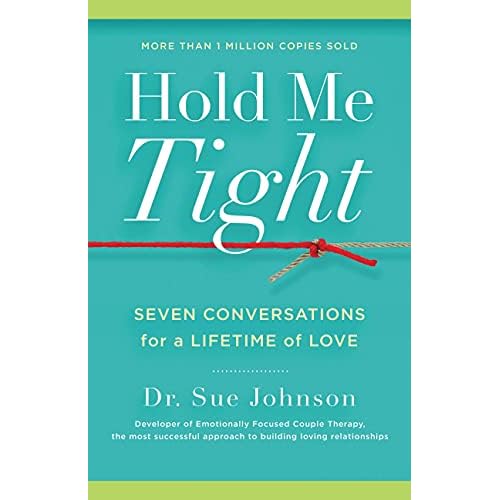
Sue Johnson
An attachment-based book for couples, organised around conversations partners have together. About 300 pages in this Little, Brown Spark hardcover. The natural next step when Attached has named a pattern and two people want to change it.
For a second view of the couple: Stan Tatkin’s Wired for Love. Tatkin also writes about attachment styles, using somewhat different labels, and he is noticeably more even-handed about the partner who needs distance. Readers who found Attached unfair to avoidant partners often find his framing easier to share with the person they are with.

Stan Tatkin
A shorter couples book on attachment styles that is more even-handed about the partner who needs distance. About 200 pages in this New Harbinger paperback.
For the anxious reader: Jessica Baum’s Anxiously Attached. A more recent book by a therapist, written for people who recognise themselves in the anxious chapters of Attached and want a fuller account of that side of the pattern. It covers ground Levine and Heller treat quickly. If what you notice most is how harshly you judge your own need for reassurance, our guide to books on self-compassion is a useful companion, and if over-functioning for a partner is the issue, the codependency books pick up where Attached stops.

Jessica Baum
A book focused on the anxious side of the pattern, covering ground Attached treats quickly. About 304 pages in this Tarcher paperback edition.
If you are reading Attached because a relationship has just ended, the book will explain the pattern but not the grief. Our guide to books for getting through a breakup covers that side, and the wider list of psychology books to understand yourself is a good place to look if attachment turns out to be only part of the question.
What is the main idea of the book Attached?
That adults bond with partners in characteristic ways, which the book groups into anxious, avoidant and secure styles, and that understanding your style and your partner’s explains a lot of relationship conflict, especially the cycle between an anxious and an avoidant partner.
Who wrote Attached and when was it published?
Amir Levine, a psychiatrist, and Rachel Heller, who trained in psychology. It was first published in 2010; the paperback most readers buy is a later Tarcher edition.
Is Attached scientifically accurate?
It is built on real research but simplifies it. Researchers usually measure adult attachment on two dimensions, anxiety and avoidance, rather than as fixed types, and how far adult styles follow from early childhood bonds is still debated.
How many attachment styles does Attached describe?
Three main ones, anxious, avoidant and secure, with a brief mention of a fourth that combines anxiety and avoidance. Other accounts, including our explainer on attachment styles, give that fourth pattern more room.
Is Attached unfair to avoidant people?
Many readers think so. The book is written largely from the point of view of someone trying to understand a partner who withdraws, and the avoidant style is often framed as the problem. Stan Tatkin’s Wired for Love is more even-handed.
What should I read after Attached?
Robert Karen’s Becoming Attached for the history and evidence, Sue Johnson’s Hold Me Tight if you and a partner want to work on a pattern together, and Jessica Baum’s Anxiously Attached if the anxious chapters described you.
Attached is a useful first map of attachment, not the territory
Attached gives readers a memorable vocabulary for closeness and distance, and its account of the anxious-avoidant cycle rings true for many people. Read it for recognition, then correct for its simplifications: the styles are tendencies that vary by relationship, the avoidant partner deserves a fairer hearing, and the adult research is more tentative than the book’s confident tone suggests.